Author

admin

Browsing

This week, Julius breaks down the current sector rotation using his signature Relative Rotation Graphs, with XLK vaulting into the leading quadrant while utilities and staples fade. He spotlights strength in the technology sector, led by semiconductors and electronic groups that are outpacing the S&P 500. Microchip heavyweights AMD, NVDA, and AVGO are displaying bullish RRG tails, reinforcing the trend. Communication Services and Energy are gaining momentum as well, rounding out a playbook that rewards disciplined trend-following amid risk from geopolitical headlines.

This video was originally published on June 20, 2025. Click on the icon above to view on our dedicated page for Julius.

Past videos from Julius can be found here.

#StayAlert, -Julius

The Fed should absolutely stop talking about being “data dependent”. That’s so far from the truth. If they were data dependent, we’d have either seen a rate cut today or Fed Chief Powell would have been discussing one for the next meeting. Inflation reports since the last Fed meeting have been benign. Economic reports, on the other hand, have shown weakness and are pointing to the need for lower interest rates.

Powell was having none of it. During Wednesday’s press conference, one reporter asked the Fed Chief why the Fed was able to lower rates in December, despite knowing that tariffs and their potential impacts were on the way. I thought it was a great question, because Powell was using future tariff impacts on inflation as the primary reason for holding rates steady today. It was a perfect illustration of The Waffler at his best. When another reporter asked Powell about his frequent comments that the Fed is data dependent and that all current data points to the need for an interest rate cut, The Waffler noted the Fed needs to “look ahead”. So which is it? Is interest rate policy being guided by current data or by looking ahead?

This is a repeat of 2021 and 2022. Remember all the inflation news and how The Waffler said inflation was transitory. I guess he was looking ahead when he made those comments. He and his band of wafflers looked ahead and got it wrong. Then, inflation data poured in higher than expected for months and he finally started his data dependency talk.

The Fed has been late to every single party for 7 years now and running. They’re running late again. Eventually, Mr. Waffler will get it right and our major indices will all move to all-time highs. For now, though, the reason for any period of consolidation or, worse yet, selling can be laid at the doorstep of none other than The Waffler.

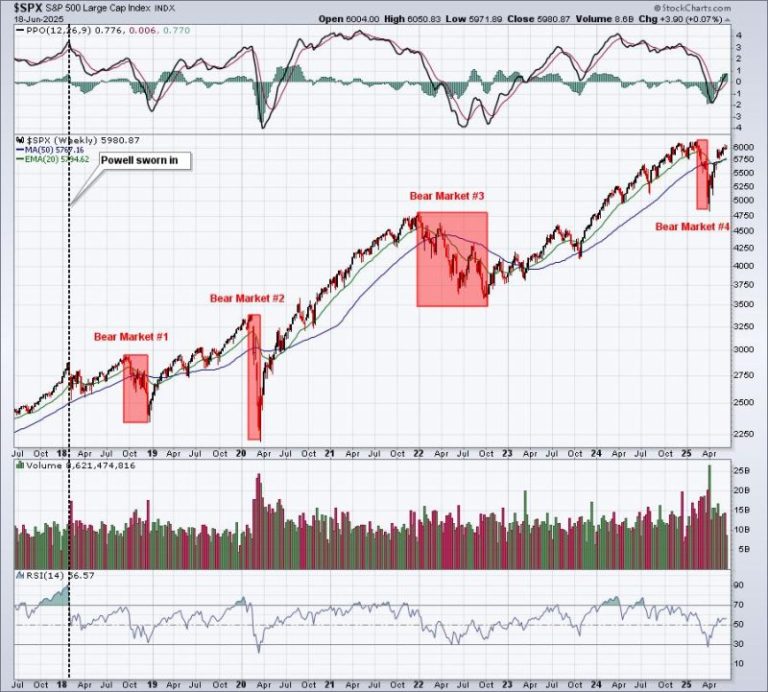
Personally, I’m exhausted by the constant “listen to what I say until I change it” approach to interest rate policy. Yes, we’ve had a 100-year pandemic and a resulting inflation problem that’s been worse than any since the 1970s. We’ve had two trade wars. I get it. But I firmly believe that the extreme volatility and the four (FOUR!!!!!!!) cyclical bear markets that we’ve endured since The Waffler became the Fed Chief is, in large part, his fault. He was sworn in on February 5th, 2018 and the stock market has been a roller coaster ever since:

Name the last time that the U.S. has seen 4 different cyclical bear markets, all starting from all-time highs, within a 7-year period. Start the Jeopardy music.

His mismanagement of interest rates didn’t start with the pandemic. I wrote an article in December 2018, during his first year, saying that his call for two rate hikes in 2019 would never happen. The next interest rate move? A cut several months later in 2019. Here’s the article I wrote back then as we bottomed in December 2018:

“How The Grinch Stole Christmas” Featuring Jerome Powell

No one has been wrong more than The Waffler.

Now maybe you’re sitting back and saying, “Tom, what’s the big deal? The tariffs are a threat. Why not just wait it out and be sure there are no lingering inflationary pressures?” Well, if you don’t mind the potential of a 5th cyclical bear market before we finally boot this guy to the curb, then I say GO FOR IT. Why try to hasten an economic meltdown when it’s unnecessary? Who believes anything The Waffler says? He said we were going to get two rate hikes in 2019. We got an interest rate cut instead. He said inflation was transitory in 2021. Then the Fed had to start raising rates at an absurd rate, because inflation skyrocketed and he waited way too long to turn hawkish. The stock market bottomed in June 2022 and was returning back towards all-time highs just prior to his infamous “more pain ahead” speech from Jackson Hole, WY on August 26th, 2022. Subsequent to that speech, the stock market fell precipitously for two months before once again finding a new bottom. That entire selling episode was caused solely by his irresponsible remarks.

And now where are we? Holding rates steady while the European Central Bank (ECB) has cut rates for 8 straight meetings. The Waffler will eventually get it right. Unfortunately, a lot of innocent investors and traders will continue to pay the price – until someone finally shows him the exit.

His term expiration cannot get here soon enough for me. GOOD RIDDANCE MR. WAFFLER!

Market Manipulation

I’ve written often about what I call the “legalized thievery” of market makers. The extreme volatility over the past several years has triggered market manipulation like we’ve never seen before. The good news is that once you understand how it works, trading the stock market gets a whole lot easier. At EarningsBeats.com we’ve timed exits out of the stock market almost perfectly, prior to the onset of cyclical bear markets. Missing out on 20%+ declines and then jumping back in at or near major bottoms increases stock market returns dramatically.

It’s time that everyone understands how the stock market works. On Saturday, June 28th, at 10:00am ET, we will be hosting a FREE webinar, “Trading the Truth: How Market Manipulation Creates Opportunity”. This event promises to be a real eye-opener, unless you’re already an EarningsBeats.com member (in which case you’ve already become a seasoned veteran regarding manipulation). Do you want to see big stock market declines before they happen? I will teach you how.

Seating is limited and this event will be packed, I can guarantee you that. PLEASE be sure to register NOW and save your spot. Again, there is NO COST. Registration is easy. Simply CLICK HERE to register and for more information.

(By the way, if you’re not available to attend LIVE on Saturday, June 28th, you should still register. All those who register will receive a copy of the recording after the event and it will be time stamped.)

Happy trading!

Tom

When the stock market seems to be drifting sideways without displaying a clear bullish or bearish bias, it’s normal for investors to get anxious. It’s like being at a crossroads, wondering whether to go left, right, or stay put.

The truth is nobody has a crystal ball, and predicting what the market will do next is a fool’s errand. Should you jump in and buy now, or wait for the price to dip lower? Instead of fretting over these questions, what you can do is empower yourself with the right tools to make informed decisions.

For one example, creating ChartLists is a terrific way to keep an eye on the charts that are important to you. 

A logical starting point is to monitor a broad market index such as the S&P 500 ($SPX), which acts as a barometer for the overall health of the market. The chart from this week’s article “Navigate the Stock Market with Confidence” highlighted some important levels to monitor. The area between 5950 and 6050 is key; a break above or below these levels can signal what’s coming next.

Below is the chart of the S&P 500, with the key levels and updated to reflect the data after Wednesday’s close. Note that the index is still within the 5950 to 6050 range. Fed Chairman Jerome Powell’s press conference didn’t do much to move the market, although there was a bit of a selloff towards the close. But that’s nothing to be alarmed about. Active participants would have unloaded their positions ahead of Wednesday’s close due to the Middle East conflict and the market being closed on Thursday to observe Juneteenth.

FIGURE 1. DAILY CHART OF THE S&P 500. Monitor the price action at key support and resistance levels.Chart source: StockCharts.com. For educational purposes.

If the S&P 500 breaks below 5950, it could mean a further decline or a market reversal. On the other hand, if the index breaks above 6050, it could indicate a move towards new highs, or it could reverse after hitting its all-time high. With so many possible outcomes, navigating the stock market can feel like a puzzle.

This is where confirmation tools become your best friends. When the overall market is wavering, these tools provide that extra bit of confidence you need.

Take the McClellan Summation Index as an example. If you’re a regular reader of our weekly ChartWatchers newsletter (and if not, you should definitely check it out — it’s packed with insights), you might recognize the chart below from last week’s issue.

FIGURE 2. NYSE MCCLELLAN SUMMATION INDEX VS. THE NYSE COMPOSITE INDEX. Note the divergence between the two and the various levels (red horizontal lines). Chart source: StockCharts.com. For educational purposes.

This chart displays the NYSE McClellan Summation Index ($NYSI) overlaid on an area chart of the NYSE Composite Index ($NYA). The McClellan Summation Index tends to generate fewer signals, making it helpful for looking at medium and long-term trends. It helps to cut through the noise of an indecisive market and gives you a clearer picture.

Notice how, after its April low, the $NYSI climbed from -590 to 688 relatively quickly in sync with the NYSE. But here’s where it gets interesting: after hitting 688, there is a divergence. While the NYSE continued to move higher, the $NYSI started trending lower, making lower highs. This could be an early warning sign that the market’s upward momentum may be waning.

The McClellan Summation Index gives us some clear levels to monitor.

  • Bearish scenario. If the S&P 500 falls below the 5950 level, followed by the $NYSI dropping below its last low of 525, then it’s likely equities could see further declines.
  • Bullish scenario. If the S&P 500 breaks above the 6050 level, followed by the $NYSI moving higher than 642 and then the 688.50 level, it would be a positive sign for equities.

The Bottom Line

So if you’re wondering when might be a good time to “buy the dip” but are unsure about when that dip might occur, these types of charting tools can help guide your investment decisions. If your indicators line up and confirm an upward move, consider investing a portion of your capital and then adding more if the market continues to move in your favor. A big part of how well you manage your finances has to do with money management.


Disclaimer: This blog is for educational purposes only and should not be construed as financial advice. The ideas and strategies should never be used without first assessing your own personal and financial situation, or without consulting a financial professional.

Canada’s tech sector saw momentum this week, with announcements spanning venture capital and quantum computing, as well as global policy leadership news out of the G7 summit.

Axl on a mission to retain Canadian innovation

On Tuesday (June 17), Axl, a newly founded Canadian venture studio, announced plans to help launch 50 artificial intelligence (AI) companies in Canada over the next five years, supported by a C$15 million fund led by co-founder Daniel Wigdor, a computer science professor at the University of Toronto.

The venture’s other founders are Tovi Grossman, another University of Toronto professor, entrepreneur Ray Sharma and former Telus (TSX:T,NYSE:TU) executive David Sharma. Mining magnate Rob McEwen of McEwen Mining (TSX:MUX,NYSE:MUX) and Smart Technologies co-founder David Martin are also investors.

According to Wigdor, Axl will tackle practical business problems and connect them with promising academic research in a bid to keep Canadian innovation at home. “The social contract academics believe we have with society is that we invent these technologies and inspire people,” he told the Globe and Mail on Tuesday. “The tragedy is that the foundational technologies we’re inventing in Canada are not accruing capital for Canada.’

Wigdor pointed to his own career as a cautionary tale, explaining that the iPhone’s multi-touch interface was presaged by research he conducted in the early 2000s for his University of Toronto thesis, which itself built on concepts pioneered by University of Toronto professor Bill Buxton in the 1980s.

Other University of Toronto AI breakthroughs fueled the international rise of figures like Geoffrey Hinton, OpenAI co-founder Ilya Sutskever and xAI’s Jimmy Ba, all of whom took their expertise to US-based companies.

Carney talks tech leadership at G7 summit

Initiatives like Axl’s signal a proactive approach to Canada’s challenge of retaining tech talent and capitalizing on its world-class research; however, its success will hinge on broader public support.

Prime Minister Mark Carney has signaled that fostering tech innovation at home is a priority. He told G7 leaders that driving the digital transition, led by AI and quantum computing, would be one of his top goals at the summit.

Quantum technology was reportedly discussed at length during the two day meeting, which took place in Kananaskis, Alberta. In addition, a joint statement from members released by the prime minister’s office indicates that Canada will launch the G7 GovAI Grand Challenge and host a series of Rapid Solution Labs “to develop innovative and scalable solutions to the barriers we face in adopting AI in the public sector.”

That emphasis echoes longstanding concerns from the research community.

A 2024 letter acquired by the Logic and sent to then-innovation minister François-Philippe Champagne by the Quantum Advisory Council cites the significant sums that other countries have invested in quantum technology.

“The cost of inaction is tremendous,” the group wrote at the time, pointing to Canada’s history of “inventing core technologies,” but letting other countries “grow industries around our inventions.”

The council proposed a C$1 billion program that would mirror the Quantum Benchmarking Initiative (QBI), which fosters domestic quantum computing in the US. The QBI has selected 18 companies for its first phase, including three from Canada; firms that demonstrate the ability to build a functional quantum computer by 2033 will be eligible to receive up to US$316 million, making it a potential “kingmaker” program.

The second phase of the program is set to launch in August 2025. While no relocation demands have been made, concerns exist that later-stage QBI terms could force Canadian winners to the US.

The Quantum Advisory Council said its proposed program would be run by the National Research Council, which would independently assess firms to accelerate the development of competitive domestic quantum companies.

It would build on a C$360 million national quantum strategy announced in April 2021.

The council’s recommendations include increased grants for scientific and social science research into quantum technologies, and a new federal clusters program to foster regional quantum ecosystems encompassing research, development and training, alongside ethical and secure use. It also calls for significant investment in quantum-safe software certification and the development of other security systems.

In a speech at the Quantum Now conference in Montreal on Thursday (June 19), Canada’s AI minister, Evan Solomon, emphasized the need to protect Canada’s talent pipeline. “We cannot allow short-term funding opportunities to hollow out our domestic capabilities or transfer generations of Canadian innovation outside our borders,” he said.

Earlier this month, the minister said he would move away from “over-indexing on warnings and regulation” and instead focus on finding ways to unleash the economic potential of AI. The ongoing collaboration between government initiatives and private ventures will be key to unlocking Canada’s full potential in the new digital era.

Securities Disclosure: I, Meagen Seatter, hold no direct investment interest in any company mentioned in this article.

This post appeared first on investingnews.com

DY6 Metals Ltd (ASX: DY6, “DY6” or the “Company”) is pleased to announce the initial visual estimations from the reconnaissance exploration program at the Douala Basin HMS Project, Cameroon. Desktop studies incorporating detailed geological mapping, geophysics, and known mineral occurrences, were used to define initial, high priority targets for ground- truthing. The reconnaissance programme, which consisted of hand auger and channel sampling, was successful in identifying high estimated concentrations of heavy mineral (HM) mineralisation across all the six tenements that make up the project. Additionally, the Company’s consultants have observed the presence of natural rutile grains within panned concentrates.

HIGHLIGHTS

  • The Company’s reconnaissance auger and channel sampling programme has been completed at the Douala Basin HMS Project
  • Reconnaissance sampling undertaken across the 6 Douala Basin tenements has identified thick zones of high estimated concentrations of heavy minerals (HM) as well as natural rutile
  • Work at the Douala Basin Project followed up on historical HM occurrences identified by previous Eramet drilling, as well as priority areas identified through the Company’s internal reviews
  • Samples collected from the reconnaissance program are due to be submitted for laboratory analysis in the coming weeks, with results expected in the September quarter
  • At Douala Basin, exploration will transition to a detailed campaign of auger drilling

Samples collected from this initial exploration programme are currently being prepped for dispatch to the Company’s laboratory for analysis in South Africa, with results expected in the September quarter.

Technical Consultant, Cliff Fitzhenry, commented:“While the Company’s primary focus is on the Central Rutile Project, where we have recently reported the presence of wide-spread residual natural rutile mineralisation, we believe that the Douala Basin HMS project has significant potential. The reconnaissance programme has over the last few weeks demonstrated the potential of the area, with the identification of high concentrations of visible heavy mineral sands across the project tenements through a mixture of auger, channel, and soil sampling work. Pleasingly, we have also observed natural rutile grains at Douala Basin.

We look forward to the assay results of the reconnaissance programme in the coming months.”

Reconnaissance exploration at the Douala Basin HMS Project

As announced on 5 June 2025, the Company commenced reconnaissance auger and grab sampling programmes at the Central Rutile and Douala Basin HMS projects, Cameroon. At the Douala Basin project, the Company has completed 12 hand auger drill holes (refer Figure 1), collecting 53 samples in the process, as well as collected 38 channel samples from 11 surfaces for analysis (refer Tables 1 & 2).

Cautionary Statement:

The Company cautions that, with respect to any visual mineralisation indicators, visual observations and estimates of mineral abundance are uncertain in nature and should not be taken as a substitute or proxy for appropriate laboratory analysis. Visual estimates also potentially provide no information regarding impurities or deleterious physical properties relevant to valuations. Assay results from the drilling and sampling programmes will be required to understand the grade and extent of mineralisation. Initial assay results are expected in August 2025.

Click here for the full ASX Release

This post appeared first on investingnews.com

Gold was on the decline this week, closing just below US$3,370 per ounce, after tensions in the Middle East pushed it past the US$3,430 level toward the end of last week.

All eyes were on the US Federal Reserve, which in a widely expected move left interest rates unchanged on Wednesday (June 18) following its two day meeting. The central bank cut rates in December 2024, but has kept them steady for its last four gatherings.

US President Donald Trump wasn’t pleased, calling Powell ‘too late’ in a Thursday (June 19) post on Truth Social. While speculation that Trump will fire Powell has died down, the president did recently say he intends to announce his next pick for the Fed leader position ‘very soon.’

Of course, Fed meetings are never just about rate decisions — experts often look to Powell’s post-meeting commentary to read between the lines of what’s said (and not said).

Tariffs were definitely in focus this time around, with Powell emphasizing that it’s still soon to tell how much of an impact they will have and how the Fed should react.

‘We have to learn more about tariffs. I don’t know what the right way for us to react will be. I think it’s hard to know with any confidence how we should react until we see the size of the effects’ — Jerome Powell, US Federal Reserve

Chris Temple of the National Investor, who offered another perspective on Powell’s comments.

He noted that while Powell didn’t say the Fed is going to abandon its 2 percent inflation target, it may be leaning in that direction. This is what he said:

The consensus still — although it was extremely close — is barely still for two 25 basis point rate cuts in the balance of 2025. Whether we get them or not, who knows, (but) that’s the current snapshot, which may well change. But that’s against a backdrop of admitting for the second SEP, summary of economic projections … in a row that inflation is going to continue to move back higher — that we’ve seen the best numbers for inflation — at the same time that GDP slows a bit.

So okay, you just told us that your favored inflation number, which is a lot of smoke and mirrors to begin with, is going to go back up to north of 3 percent, which is what they said yesterday. And yet you still — the consensus is you’re going to lower interest rates twice in 2025? So he did everything but come right out and admit that the 2 percent inflation target isn’t going to be reached.

Stay tuned to our YouTube channel for the full interview with Temple.

Bullet briefing — Silver hits 13 year high, SPUT raising US$200 million

Is silver’s price rise real?

Gold has stolen the precious metals spotlight in 2025, but this month silver is shining.

The white metal has been on the rise since the beginning of June, and this week it broke the US$37 per ounce mark for the first time in 13 years.

While silver is known to lag behind gold before playing catch up, it’s also known for its volatility. Its move has created excitement, but market participants are also wary of a correction.

When asked what factors are driving silver, Peter Krauth of Silver Stock Investor he said he sees a ‘perfect storm’ emerging. Here’s how he explained it:

You’ve got the macroeconomic picture that is I think certainly bullish for silver, like it is for gold and a lot of the other commodities. But I think at the same time you’ve got the market kind of coming to terms with the fact that silver is in a deficit, (and) it’s unlikely to be able to rectify that deficit for several years — in fact, the Silver Institute thinks we’re going to see record deficits at some point over the next five years.

And silver supply is unable to grow. We saw a peak 10 years ago in mined silver, and overall silver supply is essentially flat.

So flat supply, growing demand — demand that’s nearly 20 percent above supply — and our ability to meet those deficits is shrinking because we’re tapping into these aboveground stockpiles that have shrunk by about 800 million ounces in the last four years, which is the equivalent of an entire year’s mine supply. So it’s the perfect storm, it’s really all coming together. And I think that the market’s realizing that.

But does that necessarily mean silver is ready for a big breakout? Krauth has a target of US$40 by the end of 2025, but said silver could potentially go 10 percent above that.

For his part, Jeffrey Christian of CPM Group attributes the silver price boost to increased demand from investors, especially when it comes to exchange-traded funds and wholesale products.

He’s projecting a bumpier path forward for the metal:

You also have — the last time I looked it was like 490 million ounces of open interest in the July Comex futures contract. And that’s two weeks from first delivery. So most of the people (who) have those shorts – those are hedges of their physical inventories. They keep those hedges in place, but they roll them forward. So they’ll be buying back their Julys and selling September futures to keep that hedge in place with the next active futures contract. That buying back of the Julys could push silver prices higher.

So if you really want to talk granular prices, we wouldn’t be surprised to see the price of silver fall to US$33, US$34 an ounce, and go up to US$40 an ounce and then back to US$33 an ounce over the next four weeks.

Click the links above to watch the interviews with Krauth and Christian.

SPUT raising US$200 million

The uranium spot price made moves this week after the Sprott Physical Uranium Trust (TSX:U.U,OTCQX:SRUUF) announced a US$100 million bought-deal financing on Monday (June 16).

It was bumped up to US$200 million the same day due to strong demand.

Spot uranium has been in a consolidation phase since hitting triple-digit levels in early 2024, creating frustration among those who are waiting for the industry’s strong long-term fundamentals to be better expressed. This week’s move past US$75 per pound has helped reinvigorate investors.

Securities Disclosure: I, Charlotte McLeod, hold no direct investment interest in any company mentioned in this article.

This post appeared first on investingnews.com
This week, Microsoft (NASDAQ:MSFT) and OpenAI’s once tight alliance showed signs of strain, while Meta Platforms (NASDAQ:META) continued to source artificial intelligence (AI) talent from rival companies.

Meanwhile, SoftBank’s (TSE:9434) CEO is considering a new chip and robotics venture in Arizona, and Google (NASDAQ:GOOGL) is looking to bring AI solutions to American cities.

Read on to dive deeper into this week’s top tech stories.

1. OpenAI and Microsoft partnership faces tension

Microsoft and OpenAI’s once-close partnership is reportedly entering a tense period of renegotiation as OpenAI restructures into a public-benefit company and seeks more autonomy.

According to sources for The Information, recent negotiations have centered on reducing Microsoft’s long-term revenue share in exchange for a 33 percent stake in the newly formed entity. Additionally, OpenAI would like to limit Microsoft’s access to future models such as Windsurf, which OpenAI acquired in May.

The company has competitive concerns with Microsoft’s GitHub Copilot, according to the people.

Tensions have risen enough that some OpenAI executives are even weighing antitrust action against Microsoft, according to sources for the Wall Street Journal. In a joint statement, both companies maintained they want to continue working together; however, the Financial Times reported on Wednesday (June 18) that if they can’t reach an agreement, Microsoft is prepared to walk away and rely on its existing contract with the startup, which extends until 2030.

2. SoftBank floats trillion-dollar robotics hub in Arizona

SoftBank is reportedly interested in a trillion-dollar infrastructure project and has reached out to Taiwan Semiconductor Manufacturing Company (NYSE:TSM) as a potential collaborative partner.

Sources for Bloomberg revealed on Friday (June 20) that SoftBank founder Masayoshi Son has approached the Taiwanese chipmaker to play a “prominent role” in a manufacturing park in Arizona codenamed “Project Crystal Land,” which may serve as a major production facility for AI-powered industrial robots.

The sources said SoftBank has also approached Samsung Electronics (KRX:005930) and other companies with the idea. SoftBank officials have reportedly engaged in discussions with federal and state government officials, including US Secretary of Commerce Howard Lutnick, to explore potential tax incentives for companies onshoring high-tech manufacturing.

In other semiconductor news, Texas Instruments (NASDAQ:TXN) said on Wednesday that it will spend more than US$60 billion building seven new semiconductor facilities across the US. Meanwhile, Amazon (NASDAQ:AMZN) announced over the weekend that it will invest AU$20 billion to expand data center infrastructure in Australia by 2029.

3. Intel reportedly planning sizeable layoffs

Intel (NASDAQ:INTC) is reportedly set to implement substantial layoffs, impacting 15 to 20 percent of its factory workforce, according to an internal memo distributed on Saturday (June 14) and obtained by the Oregonian.

This move comes amidst continuing efforts to overhaul a company lagging behind its peers.

For some time, Intel’s offerings have struggled to compete effectively against those of key rivals in the highly competitive market of AI products and chip divisions. In a concerted effort to address this gap and reinvigorate its innovation pipeline, Intel has also been actively recruiting top-tier engineering talent.

On Wednesday, Intel expanded its sales and engineering leadership team to include experienced professionals from Cadence Design Systems (NASDAQ:CDNS), Apple (NASDAQ:AAPL) and Google.

These strategic hires are intended to inject fresh perspectives and expertise into crucial engineering departments, directly contributing to the company’s ambitious plans to develop more competitive and advanced AI solutions.

4. Google partners with Conference of Mayors for city AI strategies

On Friday, Google announced that it has partnered with the US Conference of Mayors to help speed the adoption of city-wide AI strategies. With the announcement, the company released a playbook titled A Roadmap for America’s Mayor that provides a framework for city leaders to develop and host an “AI Adoption Workshop,’ which would be structured to help cities identify and explore how AI can support specific needs, drawing on experiences from other communities.

The roadmap suggests cities conduct a general survey to tailor workshop content by gathering information on current AI usage, as well as concerns and ideas for AI applications. Various approaches are suggested for drafting the strategy document, including a dedicated working group, an appointed lead drafter, a hybrid model or engaging external expertise, with a recommended deadline of four to six weeks post-workshop for the first draft.

5. Meta hires top AI talent

Sources for the Information indicated on Wednesday that Meta CEO Mark Zuckerberg is bringing Daniel Gross, CEO of Ilya Sutskever’s startup Safe Superintelligence, and former GitHub CEO Nat Friedman onboard.

According to the report, Gross and Friedman will both join Meta, with Gross leaving his startup to focus on AI products at Meta and Friedman taking on a broader role. Both are expected to work directly with Zuckerberg and Scale AI CEO Alexandr Wang, who signed a US$14.3 billion deal to join Meta last week.

In exchange, Meta will get a stake in NFDG, the venture capital firm co-owned by Gross and Friedman that has backed companies such as Coinbase Global (NASDAQ:COIN), Figma, CoreWeave (NASDAQ:CRWV), Perplexity and Character.ai.

On the most recent episode of his brother’s “Uncapped” podcast, OpenAI CEO Sam Altman said that Meta has also offered signing bonuses as high as US$100 million and large compensation packages to OpenAI employees.

Securities Disclosure: I, Meagen Seatter, hold no direct investment interest in any company mentioned in this article.

This post appeared first on investingnews.com
Friday (June 20) was the last day for the spring session of Canada’s parliament before its summer break.

On the agenda for the day was a vote on bill C-5, “The One Canadian Economy Act,” which was introduced on June 5.

The bill is in part a response to the recent shift in US trade policy under Donald Trump’s administration. It will provide a new framework to fast-track projects of national interest, including mining and energy projects, to boost Canada’s economy.

However, it hasn’t been without controversy. Primarily, it has been met with opposition from some Indigenous groups, who feel it will override treaty obligations and environmental review processes.

In parliament, it also met some resistance from the conservative opposition, who amended the bill to close loopholes they felt would allow the government to skirt conflict of interest and lobbying laws.

The bill is widely expected to pass the House of Commons and the Senate, with broad support from the Conservative Party.

Also on Friday, Statistics Canada released April’s monthly mineral production survey.

The data shows across-the-board declines in both production and shipments of copper, gold and silver from the previous month.

Copper production dropped the most in April, down to 35.1 million kilograms from 40.1 million in March, while shipments slipped to 30.1 million kilograms from the 50.5 million recorded the previous month.

Gold and silver production fell slightly, with gold declining from 17,059 to 16,708 kilograms, and silver declining from 26,700 to 25,412 kilograms. However, shipments of both fell more precipitously between March and April. Gold shipments dropped from 19,049 to 14,848 kilograms, while silver shipments fell from 29,578 to 22,106 kilograms.

In the United States, the Federal Reserve held its fourth meeting of the year to determine the direction of the benchmark Federal Funds Rate on Tuesday (June 17) and Wednesday (June 18).

The central bank decided to hold the rate at the current 4.25 to 4.5 percent range, which it last set in November 2024. The decision comes as it awaits the effects of tariffs to be felt more broadly in the economy, noting uncertainty whether it will be a one-time shock or be more persistent through the rest of the year.

The decision fell in line with analysts’ expectations, who are not predicting a rate cut until the Fed’s September meeting.

Markets and commodities react

In Canada, major indexes were mixed at the end of the week. The S&P/TSX Composite Index (INDEXTSI:OSPTX) was largely flat, posting a small 0.14 percent loss during the week to close at 26,497.57 on Friday. The S&P/TSX Venture Composite Index (INDEXTSI:JX) fared worse, losing 2.18 percent to 711.18, although the CSE Composite Index (CSE:CSECOMP) jumped 1.58 percent to 117.36.

US equities were all in negative territory this week, with the S&P 500 (INDEXSP:INX) losing 0.55 percent to close at 6,967.85, the Nasdaq-100 (INDEXNASDAQ:NDX) slipping 0.23 percent to 21,626.39 and the Dow Jones Industrial Average (INDEXDJX:.DJI) sinking 0.88 percent to 42,206.83.

The gold price was down this week, losing 0.42 percent to US$3,371.39 at by Friday’s close. Although it jumped to a high of US$37.29 mid-week, the silver price pulled back and ultimately lost 0.82 percent to end the week at US$36.02.

In base metals, the COMEX copper price gained 1.88 percent over the week to US$4.88 per pound. Meanwhile, the S&P GSCI (INDEXSP:SPGSCI) posted a gain of 5.47 percent to close at 580.99.

Top Canadian mining stocks this week

How did mining stocks perform against this backdrop?

Take a look at this week’s five best-performing Canadian mining stocks below.

Stock data for this article was retrieved at 4 p.m. EDT on Friday using TradingView’s stock screener. Only companies trading on the TSX, TSXV and CSE with market capitalizations greater than C$10 million are included. Mineral companies within the non-energy minerals, energy minerals, process industry and producer manufacturing sectors were considered.

1. Royalties Inc. (CSE:RI)

Weekly gain: 183.33 percent
Market cap: C$24.75 million
Share price: C$0.085

Royalties Inc. is a company focused on building cash flow through the acquisition mineral and music royalty assets.

The company has a 100 percent interest in the Bilbao silver property in Zacatecas, Mexico, which hosts silver, zinc and lead deposits. As silver prices improve, the company is seeking to monetize the property.

Shares in Royalties Inc. surged this week after its 88 percent owned subsidiary Minera Portree won its lawsuit against Capstone Copper (TSX:CS), asserting its ownership of a 2 percent net smelter return royalty on five mineral concessions at the Cozamin copper-silver mine in Zacatecas.

The protracted legal dispute began after Capstone re-assigned the royalty to itself through a 2019 contract without informing or paying Minera Portree.

Under the terms of the judgment, the 2 percent NSR will revert back to Minera Portree along with royalties for the exploitation of concessions between 2002 and 2019. The amounts for those royalties will be set at the execution phase. Capstone Gold is also ordered to pay royalties from the Portree 1 concession from August 2019 to present.

Earlier in the week, Royalties Inc. increased its stake in Music Royalties, which pays a 7.2 percent annual yield from 30 music catalogues. The company will now receive royalties of C$102,000 per year from its investment.

2. Altima Energy (TSXV:ARH)

Weekly gain: 100 percent
Market cap: C$21.14 million
Share price: C$0.42

Altima Energy is a light oil and natural gas exploration and development company with operations in Alberta, Canada.

Its primary asset is the Richdale property in Central Alberta. The property consists of five producing light oil wells and sits on 5,920 acres of long-term reserves. According to a company presentation from April 2025, the property hosts combined proved and probable reserves of just under 2 billion barrels of oil equivalent, with a pre-tax net present value of C$25.8 million.

The company also owns two wells at its Twinning light oil site near Nisku, seven producing wells at its Red Earth property in Northern Alberta and two multi-zone wells at its Chambers Ferrier liquid gas production property.

Although Altima hasn’t released news in the last few months, its share price surged mid-week.

3. Trillion Energy (CSE:TCF)

Weekly gain: 71.43 percent
Market cap: C$11.62 million
Share price: C$0.06

Trillion Energy is an oil and gas producer focused on supplying the European and Turkish markets.

The company owns a 49 percent share in the SASB gas field with Turkish Petroleum (TPAO) owning the remainder. The field is located in the southwestern Black Sea, and covers a license block area of 12,387 hectares. Trillion also owns a 19.6 percent interest in the Cendre oil field, with TPAO owning the majority 80 percent.

On April 26, the company released its 2024 year end reserve report. In the announcement, Trillion reported that its attributable total proved and probable reserves at the SASB gas field increased to 62.3 billion cubic feet of gas and 247 million barrels of oil, with a pre-tax NPV of US$363.6 million.

Trillion Energy’s share price climbed in the second half of the week. Although it did not put out a press release, the company stated in posts on X Wednesday and Friday that the partners are “actively engaged on-site” advancing gas lift operations through “carefully managed on-platform efforts.”

4. Search Minerals (TSXV:SMY)

Weekly gain: 52 percent
Market cap: C$18.81 million
Share price: C$0.380

Search Minerals is a rare earth element exploration and development company working to advance its flagship Deep Fox project in Newfoundland and Labrador, Canada.

The project is located near the port of St. Lewis on the Southeast Labrador coast and consists of 63 mineral claims covering an area of 1,575 hectares. The company also owns the nearby Foxtrot deposit. A May 2022 technical report reported a combined indicated mineral resource estimate for the two properties of 375 parts per million (ppm) praseodymium, 1,402 ppm neodymium, 185 ppm dysprosium and 32 ppm terbium from 15.09 million metric tons of ore.

Search Minerals released a corporate update on June 13 announcing that its shares were being reinstated for trading on the TSXV. The update detailed how, under previous management, the company’s TSXV listing was subject to a cease trade order in April 2024 due to the previous management team failing to file annual financial statements for 2023. Search’s new board and management team, elected and appointed in mid-2024, brought the company back into compliance.

Search recommenced trading Monday, and its shares climbed on June 19 after the company announced unreleased assay results from a 2022 Phase 4 drill program at Deep Fox. Highlighted assays included one hole with a 29.92 meter interval grading 256 ppm dysprosium, 1,848 ppm neodymium, 496 ppm praseodymium and 43.5 ppm terbium.

The company said the results validate their belief in the mineralization at the site, and that it would drive forward development of Deep Fox, which it called a generational asset, without delay.

5. Homeland Nickel (TSXV:SHL)

Weekly gain: 50 percent
Market cap: C$12.26 million
Share price: C$0.06

Homeland Nickel is an exploration company with projects in the US and Canada.

The company owns four nickel projects in Oregon: Cleopatra, Red Flat, Eight Dollar Mountain and Shamrock. The projects are in the early exploration stage, with the company being guided by historic work at each property.

Homeland is also working on the Great Burnt copper-gold project in Newfoundland and Labrador, Canada. The project is a 30/70 joint venture with Benton Resources (TSXV:BEX,OTC Pink:BNTRF), which earned its stake in the property through an earn-in agreement with Homeland in July 2024.

While the company did not release any news, on June 11, Noble Mineral Exploration (TSXV:NOB) and Canada Nickel’s (TSXV:CNC) announcement on June 11 of positive assay results from their joint venture Mann nickel project in Ontario. Homeland owns 2.95 million shares in Canada Nickel and 9.96 million shares of Noble.

FAQs for Canadian mining stocks

What is the difference between the TSX and TSXV?

The TSX, or Toronto Stock Exchange, is used by senior companies with larger market caps, and the TSXV, or TSX Venture Exchange, is used by smaller-cap companies. Companies listed on the TSXV can graduate to the senior exchange.

How many mining companies are listed on the TSX and TSXV?

As of February 2025, there were 1,572 companies listed on the TSXV, 905 of which were mining companies. Comparatively, the TSX was home to 1,859 companies, with 181 of those being mining companies.

Together the TSX and TSXV host around 40 percent of the world’s public mining companies.

How much does it cost to list on the TSXV?

There are a variety of different fees that companies must pay to list on the TSXV, and according to the exchange, they can vary based on the transaction’s nature and complexity. The listing fee alone will most likely cost between C$10,000 to C$70,000. Accounting and auditing fees could rack up between C$25,000 and C$100,000, while legal fees are expected to be over C$75,000 and an underwriters’ commission may hit up to 12 percent.

The exchange lists a handful of other fees and expenses companies can expect, including but not limited to security commission and transfer agency fees, investor relations costs and director and officer liability insurance.

These are all just for the initial listing, of course. There are ongoing expenses once companies are trading, such as sustaining fees and additional listing fees, plus the costs associated with filing regular reports.

How do you trade on the TSXV?

Investors can trade on the TSXV the way they would trade stocks on any exchange. This means they can use a stock broker or an individual investment account to buy and sell shares of TSXV-listed companies during the exchange’s trading hours.

Article by Dean Belder; FAQs by Lauren Kelly.

Securities Disclosure: I, Dean Belder, hold no direct investment interest in any company mentioned in this article.

Securities Disclosure: I, Lauren Kelly, hold no direct investment interest in any company mentioned in this article.

This post appeared first on investingnews.com

Americans traveling abroad are being urged to exercise caution worldwide, as the war between Israel and Iran has resulted in travel disruptions globally.

The U.S. State Department issued a warning to those traveling around the world, citing the potential for demonstrations against U.S. citizens.

‘The conflict between Israel and Iran has resulted in disruptions to travel and periodic closure of airspace across the Middle East,’ the State Department said in its Worldwide Caution advisory. ‘There is potential for demonstrations against U.S. citizens and interests abroad. The Department of State advises U.S. citizens worldwide to exercise increased caution.’

Last week, the State Department warned U.S. travelers to not travel to places like Israel, Gaza and the West Bank because of armed conflict, terrorism and civil unrest.

The threat comes as terrorist groups, lone-actor terrorists and other violent extremists continue to plot possible attacks in those areas with little to no warning, targeting tourist locations, transportation hubs, markets and local government facilities.

Government officials in Turkey have also been cautioned to maintain a low profile and avoid personal travel to the country’s southernmost provinces.

The alert issued on Sunday reads, ‘Negative sentiment toward U.S. foreign policy may prompt actions against U.S. or Western interests’ in Turkey.

It adds that activities in the past have included demonstrations, calls for boycotts of U.S. businesses, anti-U.S. rhetoric and graffiti.

If traveling abroad, the State Department advised reviewing its website for alerts pertaining to the specific destination being visited.

The advisory comes after President Donald Trump ordered military strikes on Iran’s key nuclear facilities in what officials are calling ‘Operation Midnight Hammer.’

After the bombing, Iranian officials warned of retaliation against the U.S.

The State Department often issues alerts and travel advisories for Americans overseas.

The travel advisories range from ‘exercise normal precaution’ to ‘Do Not Travel,’ which is reserved for parts of the world where there is ongoing conflict, ethnic or religious discrimination or where U.S. citizens are generally not welcome.

Other reasons for alerts include crime rates, health concerns and piracy in some parts of the world. 

This post appeared first on FOX NEWS

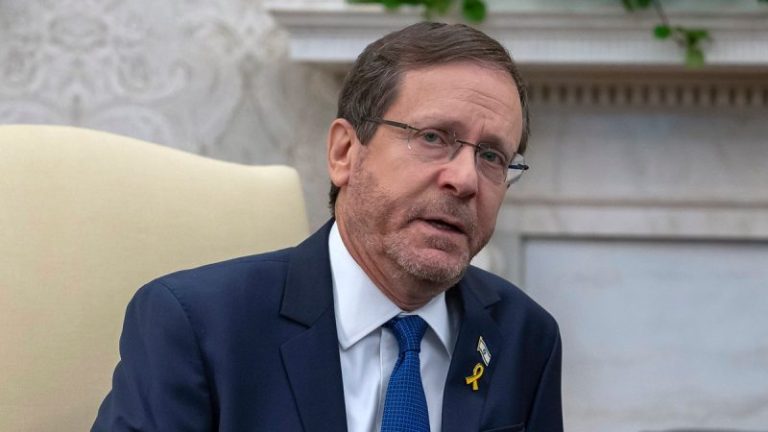
Israeli President Isaac Herzog said that Israel is ‘not dragging’ the U.S. into its war with Iran, pushing back against growing fears of a broader regional conflict after Washington sent an overnight strike against three major Iranian nuclear facilities on Saturday.

Herzog made the statement during an appearance on CNN’s ‘State of the Union’ with host Kasie Hunt on Sunday, in response to President Donald Trump’s decision to deploy bunker-buster bombs and Tomahawk missiles against Iran’s key nuclear sites at Fordow, Natanz and Isfahan.

‘We made clear throughout that we are not dragging America into a war,’ Herzog said. ‘We are leaving it to the decision of the President of the United States and his team, because it had to do with America’s national security interests, period. We are not intending, and we don’t ask for America now to go to war because the Iranians are threatening Israel.’

The Israeli leader added that the American decision to attack Iran’s nuclear infrastructure was ‘the right step’ for the U.S., describing the Iranian nuclear program as a threat to American and global security. 

‘The decision was taken because the Iranian nuclear program was a clear and present danger to the security interests of all the free world, especially the leader of the free world,’ Herzog added. ‘America, as the leader of the free world, was actually at risk from this program, and that is why it was the right step to do.’

Despite Washington’s military involvement, Herzog stressed that now is ‘the moment where one thinks about diplomacy.’ He urged that any renewed talks with Iran must ‘be nuts and bolts and very clear,’ citing a history of previously failed negotiations due to what he described as Iranians ‘lying constantly.’

Secretary of State Marco Rubio also reiterated Herzog’s message during an appearance on Fox News’ ‘Sunday Morning Futures’ with host Maria Bartiromo, asserting that the U.S. is ‘not at war’ with Iran. 

Rubio added that regime change is ‘not the goal’ and that Washington is still offering a diplomatic path forward. 

This post appeared first on FOX NEWS