Author

admin

Browsing

Walmart has agreed to pay $10 million to settle a Federal Trade Commission civil lawsuit accusing the world’s largest retailer of ignoring warning signs that fraudsters used its money transfer services to fleece consumers out of hundreds of millions of dollars.

The settlement was filed on Friday in Chicago federal court, and requires approval by U.S. District Judge Manish Shah.

Walmart also agreed not to process money transfers it suspects are fraudulent, or help sellers and telemarketers it believes are using its services to commit fraud.

“Electronic money transfers are one of the most common ways that scammers tell consumers to send them money, because once it’s sent, it’s gone for good,” said Christopher Mufarrige, director of the FTC consumer protection bureau. “Companies that provide these services must train their employees to comply with the law and work to protect consumers.”

The Arkansas-based retailer did not admit or deny wrongdoing in agreeing to settle. Walmart did not immediately respond to requests for comment.

In its June 2022 complaint, the FTC accused Walmart of turning a blind eye to fraudsters who used its money transfer services to cash out at its stores.

Walmart acts as an agent for money transfers by companies such as MoneyGram and Western Union. Money can be hard to trace once delivered.

The FTC said fraudsters used many schemes that included impersonating Internal Revenue Service agents, impersonating family members who needed money from grandparents to avoid jail, and telling victims they won lotteries or sweepstakes but owed fees to collect their winnings.

Shah dismissed part of the FTC case last July but let the regulator pursue the remainder. Walmart appealed from that decision. Friday’s settlement would end the appeal.

This post appeared first on NBC NEWS

President Donald Trump expressed deep frustration with both Israel and Iran on Tuesday, saying the two countries ‘don’t know what the **** they’re doing.’

Trump made the comments while departing from the White House for a NATO summit Tuesday morning. Both Israel and Iran fired missiles at one another following the imposition of a ceasefire on Monday night.

‘I’m not happy with Israel. You know, when I say, okay, now you have 12 hours, you don’t go out in the first hour and just drop everything you have on them. So I’m not happy with them. I’m not happy with Iran either, but I’m really unhappy if Israel is going out this morning,’ Trump said.

He continued, ‘We basically have two countries that have been fighting for so long and so hard that they don’t know what the **** they’re doing.’ 

‘I’m gonna see if I can stop it,’ he added.

‘ISRAEL. DO NOT DROP THOSE BOMBS. IF YOU DO IT IS A MAJOR VIOLATION. BRING YOUR PILOTS HOME, NOW!’ Trump wrote on Truth Social shortly after boarding Marine One.

Minutes later, he announced that Israel was canceling its plans for an attack Tuesday morning.

‘ISRAEL is not going to attack Iran. All planes will turn around and head home, while doing a friendly ‘Plane Wave’ to Iran. Nobody will be hurt, the Ceasefire is in effect! Thank you for your attention to this matter!’ he wrote.

He then topped it off with a post stating: ‘IRAN WILL NEVER REBUILD THEIR NUCLEAR FACILITIES!’

Trump announced a ceasefire between Israel and Iran on Monday night, dubbing the conflict a ’12-day war.’

Qatar’s prime minister secured Iran’s agreement to the U.S.-proposed ceasefire after Iran’s limited strikes on America’s Al-Udeid Air Base in Qatar.

A senior Israeli official told Fox News on Tuesday that Iran had launched two missiles toward Israel following the announcement of the ceasefire ‘and we believe they are trying to fire more in the next couple of hours.’

‘Unfortunately, the Iranians have decided to continue to fire toward Israel,’ the official said to Fox News Chief Foreign Correspondent  Trey Yingst after Trump unveiled the deal Monday.

‘Now we will have to retaliate, this will happen of course,’ the official added. ‘It could end within several hours, but they [the Iranians] need to make a decision.’ 

Israel has yet to confirm that it has canceled its follow-up attack.

This post appeared first on FOX NEWS

The S&P MidCap 400 SPDR (MDY) is trading at a moment of truth as its 5-day SMA returns to the 200-day SMA. A bearish trend signal triggered in early March. Despite a strong bounce from early April to mid May, this signal remains in force because it has yet to be proven otherwise. Today’s report will show how to quantify signals and reduce whipsaws using the percentage difference between two SMAs.

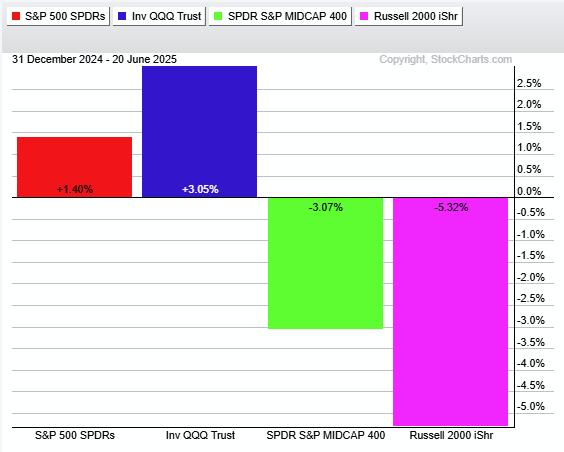
First note that MDY is lagging SPY and QQQ because its 5-day has yet to cross above its 200-day. The latter two saw bullish crosses in mid May, over a month ago. A bullish breakout in MDY would reflect broadening upside participation, which would be bullish for stocks. The PerfChart below shows SPY and QQQ with year-to-date gains. MDY and IWM are down year-to-date. 


***********************

TrendInvestorPro continues to follow the leading uptrends and recent breakouts in metals-related ETFs. These include gold, silver, palladium, platinum, copper and associated miners. Tech-related ETFs are also leading and featured in our reports/videos. Click here to learn more and get full access to our research.

***********************

The chart below shows MDY hitting its moment of truth as the 5-day SMA (black line) bumps against the underside of the 200-day SMA (blue line). A bearish cross occurred in late February and this signal has yet to be reversed. However, I am not watching for a simple 5/200 cross. Instead, I want to see the 5-day SMA clear the 200-day SMA by a certain percentage. This is a signal threshold.

The indicator window shows Percent above MA (5,200,1), which measures the percentage difference between the 5 and 200 day SMAs. See the TIP Indicator Edge Plugin for details. I placed signal thresholds at +3% and -3% to reduce whipsaws. A bullish signal triggers with a move above +3% and a bearish signal triggers with a move below -3%. At the very least, this indicator value is still negative and bearish. A move above 0 would reflect a positive 5/200 cross, while a move above +3% would trigger a bullish trend signal. This indicator is part of the TIP Indicator Edge Plugin for StockCharts ACP.

The signal threshold levels depend on your personal preferences and trading styles. Tighter thresholds generate earlier signals, but with more whipsaws. Wider thresholds reduce whipsaws, but increase signal lag. This is always the tradeoff. I prefer plus/minus 1 percent when using the 5/200 cross for SPY. I widened these thresholds to plus/minus 3 percent for MDY because it is more volatile.

TrendInvestorPro continues to follow the leading uptrends and recent breakouts in metals-related ETFs. These include gold, silver, palladium, platinum, copper and associated miners. Tech-related ETFs are also leading and featured in our reports/videos. Click here to learn more and gain immediate access. 

With President Donald Trump’s extraordinary decision to attack three of the key/critical Iranian nuclear sites, two questions emerge: First, how will the Iranian populace react to the decision? Second, will this hurt or help the chances for regime change?

Of course, we will not get answers to these questions immediately. But I think it’s fair to say that history, in the not-so-distant past, offers an instructive guide to what could well happen. 

While it is challenging at this point to answer these questions with a high degree of certainty, there is one historical analogy which I was deeply involved in that may provide insights.

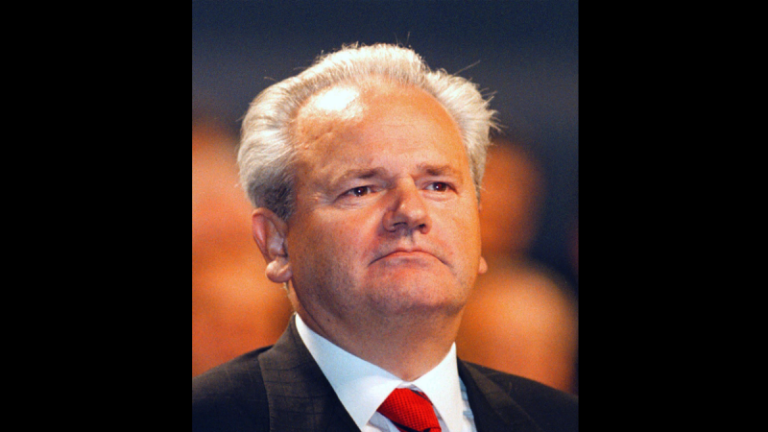
More than 24 years ago, while working in the Bill Clinton administration, I was one of the principal actors advising the State Department on the situation in Serbia. There, I led on-the-ground efforts to demonstrate to the Serbian opposition that President Slobodan Milosevic could be beaten.

At the time, many in both the U.S. and Serbia thought that nearly 80-days of NATO bombings and the 1999 Kosovo war had produced a rally around the flag effect in favor of Milosevic.

And yet, the polls I conducted conclusively demonstrated the opposite. 

The data revealed that, despite efforts by the regime to portray Milosevic as strong and popular, he was extremely weak, with a 70% unfavorable rating.

As was acknowledged in the Washington Post at the time, the strategic guidance I provided based on those polls led to the development of a campaign that soon toppled a regime few thought was quite so vulnerable.

There are striking parallels between Milosevic’s downfall and the situation the Khamenei regime finds itself in today.

In both, there are some who feel that foreign airstrikes would strengthen nationalist sentiment in favor of a regime that prioritizes projecting an aura of popularity despite being incredibly disliked by its citizens. 

Further, in Serbia, we found that there was pervasive anger towards the government, particularly over the poor state of the economy. In Iran, there is similar – if not even more intense – dissatisfaction with the regime’s chronic mishandling of economic and national policy.

To be sure, polling data from inside Iran is limited, although Stasis, a firm which specializes in conducting methodologically-sound surveys in the country, released a poll last October that is telling.

They found that nearly 8-in-10 (78%) Iranians feel that the government’s policies are to blame for the country’s economic struggles.

Additionally, in a country of 90 million, where roughly 60% are under the age of 30, the same poll shows that more than three-quarters (77%) of Iranians believe that ‘Iranian youth do not see prosperity for their future in Iran.’

All of this is to say that like Milosevic’s regime, the Iranian government appears to have strong popular support, but underneath the surface, is extremely weak and vulnerable.

For many, the idea that Israel – and especially Prime Minister Benjamin Netanyahu – could bring about regime change in Iran is hard to take seriously. 

But, a more detailed examination of the current situation, as well as Iran’s own recent history, supports the notion that Netanyahu could be more accurate than not.

Consider the history: Since 2009, there have been 10 nationwide protest movements, with millions of Iranians taking to the streets against the government.

And while there was a wide range of causes for those protests – from blatant election fraud to the most recent demonstrations set off by the killing of Mahsa Amini – they all underscore widespread opposition to the current regime. 

In that same vein, much like I saw in Serbia, the large number of protests and their various causes reveal a significantly large opposition that, under the right conditions, can effectively mobilize and pressure the regime. 

To that end, whereas we had to actively organize those movements in Serbia, those conditions are already evident in Iran, and on a much greater scale.

Aside from the bleak future facing Iran’s youth, the regime’s oppressive laws towards its nearly 44 million female citizens have turned virtually one-half of the population into second-class citizens with little to lose from rising up, as hundreds of thousands did during the 2022 Mahsa Amini protests. 

Underscoring just how deep the hatred is towards the regime, Iran International has reported receiving letters expressing personal thanks to Netanyahu, and the Jerusalem Post reported than an Iranian source told them, ‘This war has greatly strengthened and revived new optimism’ among Iranians for regime change.

The Post’s source inside Iran continued, saying that ‘conversations around the capital city (Tehran) are focused on the final days of the regime and that they brought it on themselves.’

Outside of Iran, the debate has already begun.

On one side are leaders such as Israeli Prime Minister Benjamin Netanyahu, as well as journalists like former National Security Advisor John Bolton, and Yorktown Institute President Seth Cropsey.

Those men have argued – Bolton and Cropsey in the Wall Street Journal, and Netanyahu speaking to Fox News’ Bret Baier and in other forums – that this is the most opportune moment for regime change in Iran since the revolution in 1979.

Given the deep reservoir of anti-regime sentiment among the Iranian people, the argument goes, the best course of action is that Israel’s destruction of the regime’s military and symbols of power will give Iranians the courage to rise up, united, against the government.

On the other side of the debate are those such as French President Emmanuel Macron. Haunted by failed regime change efforts in Iraq and Libya, Macron cast doubt on the possibility for success in pursuing regime change, saying it would ‘result in chaos.’

Some have also argued that Israel’s actions could create a ‘rally around the flag’ effect and spark nationalism among the Iranian people.

To be clear, while both sides have legitimate arguments, based off my experience in Serbia, I believe that Netanyahu and those on his side have a much stronger case.

The Iranian government is weaker than ever before after Israel destroyed virtually its entire chain of command and remains in total control of Iranian skies.

Likewise, unlike Libya and Iraq, Iran has a well-organized opposition, with a much more established sense of national unity than either Iraq or Libya ever had.

Taken together, there is strong evidence underpinning Israel’s belief that the Iranian regime could fall, especially given Israel’s extreme caution in only targeting symbols of the regime in order to avoid stoking nationalism.

Of course, there are risks in encouraging regime change, and it’s not at all guaranteed that the next regime is the one the West wants. It could very well result in a more extreme government led by remnants of the Revolutionary Guard hard-liners.

However, it is a mistake of similar magnitude to dismiss this chance out of hand. History has shown that when an oppressed people, angry at their government, find their confidence and are supported – even only by air power – the outcome need not be chaos, or the survival of the current government. 

It has, and could again, result in genuine regime change.

In both cases of Iran and Serbia there was widespread bombing of the country and indeed the civilians, with collateral damage on the civilian population. In the Serbian case all of the net results was that it strengthened the resolve of the Serbian people to rid themselves of an authoritarian dictator – Milosevic. And in the Iranian case, if history is any guide, it will weaken an already fragile regime and hopefully provide an outlet for the millions of Iranians who want a greater measure of freedom and peace in their lives.

This post appeared first on FOX NEWS

President Donald Trump will be engaging in numerous foreign policy discussions this upcoming week at a NATO summit, where more than just Ukraine will be the focus of conversations between foreign leaders. 

A senior Trump official told the Wall Street Journal Sunday that the president still intends to attend the summit that will be held in The Hague, starting Wednesday. He will depart for the Netherlands on Tuesday and arrive late in the evening the same day. 

It is a slight schedule change from his originally planned departure date of Monday, per previous reports.

Trump was expected to attend a state dinner between foreign leaders on Tuesday evening, but it is unclear whether he will still attend due to the late-Tuesday arrival time. The White House did not respond to Fox News Digital’s requests for additional information about the president’s schedule.

The schedule change comes after the president recently abruptly left the G7 economic summit in Canada to attend to the ongoing situation in the Middle East that tamped up Saturday.

The summit between foreign leaders will likely include conversations about Trump’s recent decision to involve the United States in Israel’s campaign in the Middle East. 

Ukrainian President Volodymyr Zelenskyy is expected to be in attendance as well, with leaders expected to discuss ongoing assistance to Ukraine amid its ongoing war with Russia. However, Ukraine’s crisis is not expected to be the central issue of concern, with global tensions in Iran likely to take a major chunk of the summit’s attention. 

Leaders are also expected to discuss NATO Secretary-General Mark Rutte’s proposal that each member country contribute at least 5% of their gross domestic product to defense spending. The idea, framed as a Trump win, has been rejected by Spain, while others have taken issue with the speed at which the move to increase NATO-member defense spending has taken.

The summit will end Wednesday and Trump will depart back to Washington thereafter. There will be heavy security and protesters have already taken to the streets in protest of the upcoming summit.

This post appeared first on FOX NEWS

The House Republican campaign committee is taking aim at congressional Democrats whom they charge are ‘pushing the largest tax hike in generations.’

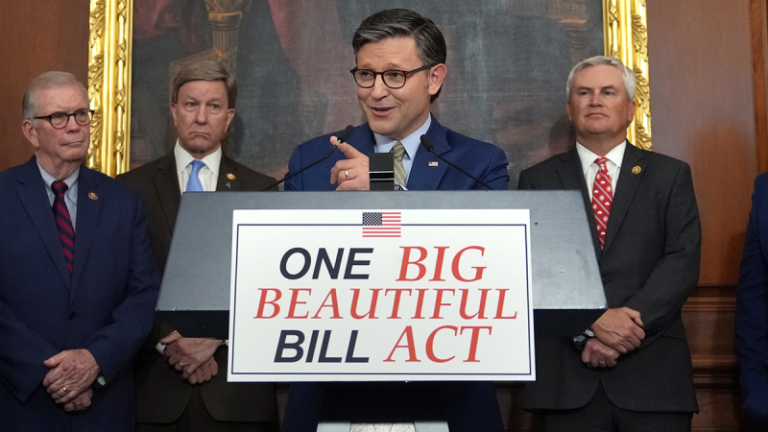
As part of their aggressive messaging following the passage last month of the GOP’s landmark spending and tax cut bill – dubbed by President Donald Trump as his ‘big, beautiful bill’ – the National Republican Congressional Committee (NRCC) is launching ads on Monday against 25 House Democrats who likely face challenging re-elections in the 2026 midterms.

‘Democrats jacked up inflation, making life more expensive for all of us. We need help. Now, they’re pushing the largest tax hike in generations,’ charges the narrator in the digital ads, which were shared first with Fox News.

The narrator argues that the Democrats being targeted in the ads are ‘completely out of touch’ and urges viewers of the spots to tell the Democratic lawmakers to keep their ‘hands off your hard-earned money.’

The bill passed the House of Representatives last month by just one vote, along partisan lines. And Trump is pushing for a July 4 deadline for the measure to pass through Congress and land on his desk at the White House.

The GOP-crafted measure is stuffed full of Trump’s campaign trail promises and second-term priorities on tax cuts, immigration, defense, energy and the debt limit. It includes extending his signature 2017 tax cuts, which are set to sunset this year without action by Congress – and eliminating taxes on tips and overtime pay. 

But the measure, if signed into law, would likely even further fuel the nation’s massive budget deficit. The national debt currently sits at $36,215,397,741,847.76 as of June 18, according to FOX Business’ National Debt Tracker. 

The spots, backed by a modest ad buy, are targeting California Democrats Josh Harder (9th District), Adam Gray (13th), George Whitesides (27th), Derek Tran (45th) and Dave Min (47th), and Florida’s Darren Soto (9th) and Jared Moskowitz (23rd).

Also included are Reps. Frank Mrvan (1st) of Indiana, Jared Golden (2nd) of Maine, Kristen McDonald Rivet (8th) of Michigan, Don Davis (1st) of North Carolina, Nellie Pou (9th) of New Jersey, Gabe Vasquez (2nd) of New Mexico, Dina Titus (1st), and Susie Lee (3rd), and Steven Horsford (4th) of Nevada.

The NRCC ads also take aim at Reps. Tom Suozzi (3rd), Laura Gillen (4th) and Josh Riley (19th) of New York, Marcy Kaptur (9th) and Emilia Sykes (13th) of Ohio, Henry Cuellar (28th) and Vicente Gonzalez (34th) of Texas, Eugene Vindman (7th) of Virginia, and Marie Gluesenkamp Perez (3rd) of Washington state.

Democrats are working to win back control of the House in next year’s midterms, as the GOP defends its razor-thin majority in the chamber.

‘Out of touch House Democrats lit the fire of inflation and tried to slap Americans with the biggest tax hike in decades, all to fund their radical agenda. Voters won’t forget this betrayal – not now, not next November,’ NRCC spokesman Mike Marinella claimed.

A memo last month by the NRCC encouraged House Republicans to make the tax cuts a priority as they defended their votes on the tax and spending bill, and to take aim at Democrats for pushing to raise taxes on average Americans.

The memo highlighted that the bill ‘prevents tax increases to put more money in every American’s pocket.’

As Democrats attack the bill, they’re highlighting the GOP’s proposed restructuring of Medicaid – the nearly 60-year-old federal program that provides health coverage to roughly 71 million low-income Americans.

The changes to Medicaid, as well as cuts to food stamps, another one of the nation’s major safety net programs, were drafted in part as an offset to pay for extending Trump’s 2017 tax cuts. The measure includes a slew of new rules and regulations, including work requirements for many of those seeking Medicaid coverage.

Democrats have relentlessly attacked Republicans over what they say will be ‘huge cuts’ to Medicaid if the bill becomes law.

But the NRCC pushes back, saying in its memo that it is ‘protecting Medicaid by removing illegal immigrants and eliminating fraud.’

This post appeared first on FOX NEWS
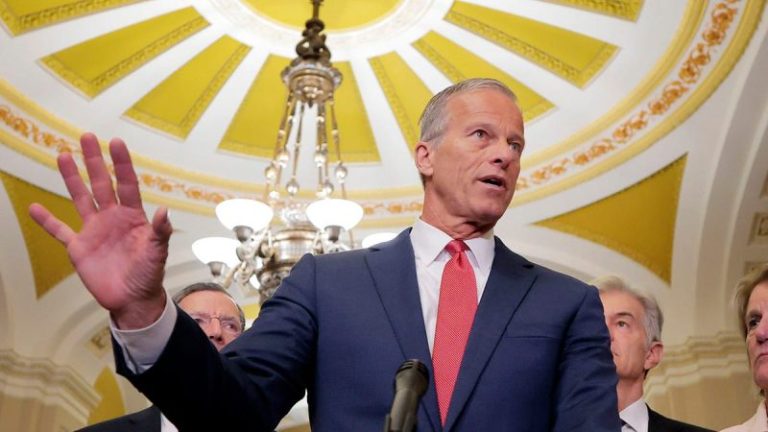
All eyes will be on the United States Senate this week as we endeavor to pass the shared Republican agenda of American strength, security, and prosperity.

With the Republican reconciliation bill, we have the opportunity to deliver. It is one that doesn’t come around often, and our country stands to benefit greatly by Republicans seizing this moment and getting this bill across the finish line.

In large part, this bill is the culmination of President Trump’s campaign promises and the promises that Republican senators have made to our voters. Chief among them is keeping the American people safe through strong border security and a military strong enough to deter threats and conflicts around the world before they begin. 

President Trump has achieved remarkable success in ending the Biden border crisis and removing the criminal illegal aliens that President Biden let walk into our country – but it hasn’t been cheap, and the administration has told us that resources are running out. This bill will fully fund the border wall and President Trump’s successful policies for the entirety of his presidency, removing any possibility that Democrats will hold those resources hostage to try to increase other government spending.

This same principle also applies to defense funding. Recent conflicts around the world should make clear the need to have a modern and lethal fighting force that can keep the American people safe. This means smart, generational investments like President Trump’s Golden Dome for America to defend against advanced drones, missiles, and hypersonics, as well as prioritizing building new ships and unmanned vehicles.

A nation cannot prosper unless it is secure, and with our borders and defense capabilities bolstered, the next key pillar of this bill is creating prosperity in America.

We do this through permanently extending President Trump’s signature achievement in his first term, the 2017 Tax Cuts and Jobs Act (TCJA). The American people are facing a hefty $4 trillion tax increase at the end of the year, the largest in American history. If we fail to act, the average family of four making the median income in the United States will face a $1,700 tax increase. Not only does this bill prevent that tax increase, it makes the TCJA’s low rates permanent – meaning Democrats can never again try to use a pending expiration as leverage for advancing wasteful government spending. 

The bill locks in the TCJA’s small business provisions for all time, which is crucial for economic growth, and it also delivers on President Trump’s tax promises: No tax on tips, no tax on overtime, relief from Social Security taxes for seniors, and no tax on interest for vehicles made in the United States.

In the wake of the Biden administration and Democrats exploding the growth of government spending on programs like Medicaid, we will make commonsense reforms to return to a fiscally sustainable path. That means kicking illegal immigrants off of health programs and introducing work requirements that even 50% of Democrats agree with – all to ensure that programs like Medicaid are strengthened and able to deliver for the American citizens the programs were designed to benefit.

Senators have worked to develop this bill for well over a year now. Now it is time to act. Border resources are drying up. National security needs have never been more apparent. And with each passing day, we move closer to reaching both our nation’s debt limit and the largest-ever tax increase on the American people. 

 Senators return to Washington today and we will remain here until this bill is passed. We know that Democrats will fearmonger and misrepresent our efforts, and we expect them to drag this debate long into the night with unrelated issues. However, I am confident we will get this bill across the finish line.

 On the Fourth of July, Americans celebrate our freedoms and the work of previous generations to keep this great American experiment going. By placing this historic bill on the president’s desk by the Fourth of July, Republicans will be ensuring that future generations of Americans can live in safety and prosperity.

This post appeared first on FOX NEWS
The White House Office of Science and Technology on Monday directed federal agencies to implement ‘gold standard science’ principles to depoliticize science and restore public trust, Fox News Digital has learned.

White House Office of Science and Technology Policy Director Michael Kratsios sent guidance to federal research agencies Monday morning, incorporating President Donald Trump’s executive order on ‘Restoring Gold Standard Science.’

Fox News Digital exclusively obtained the guidance sent to federal agencies.

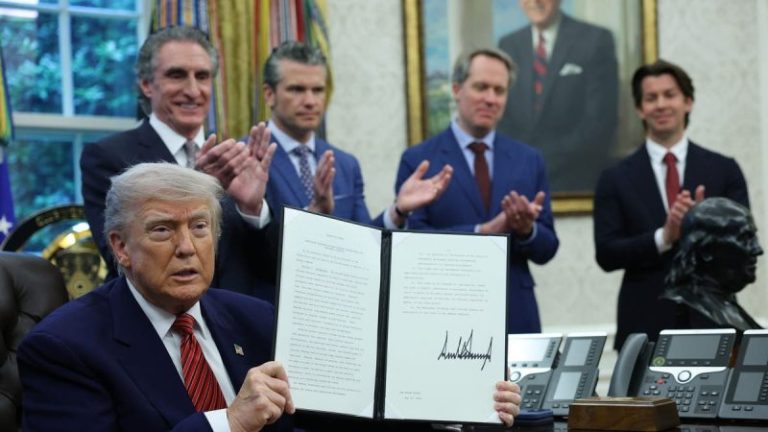
President Trump, in May, signed an executive order to restore ‘Gold Standard Science’ as the cornerstone of federal scientific research.

‘Gold Standard Science’ is ‘reproducible, transparent and falsifiable,’ according to the order. 

It is also ‘subject to unbiased peer review; clear about errors and uncertainties; skeptical of assumptions; collaborative and interdisciplinary; accepting of negative results as positive outcomes; and free from conflicts of interest.’ 

The executive order reinstated ‘the scientific integrity policies’ of the first Trump administration and ‘ensures that science is no longer manipulated or misused to justify political ends.’ 

‘President Trump’s Gold Standard Science EO will transform the conduct and management of federal science, from research design to public communication, in order to strengthen scientific inquiry, rebuild public trust, and ensure the U.S. continues to be the global leader in rigorous, evidence-based science,’ Kratsios told Fox News Digital. ‘But federal agencies are only one part of our nation’s research ecosystem.’

Kratsios added, ‘American universities, scientific journals, industry and philanthropic leaders all have a crucial role in improving the overall quality of research, and we encourage this executive action to serve as a model for the entire scientific enterprise.’

Kratsios sent the memo to federal agencies Monday morning to provide guidance to federal departments and agencies on implementing gold standard science ‘in the conduct and management of all aspects of their scientific activities, from research design to public communication.’

‘By adopting these standards, agencies will strengthen scientific inquiry, rebuild public trust, and ensure the United States continues as the global leader in rigorous, evidence-based science,’ the memo states.

Kratsios said that ‘Gold Standard Science’ represents a ‘commitment to the highest standards of scientific integrity, defined by nine core tenets: reproducible; transparent; communicative of error and uncertainty; collaborative and interdisciplinary; skeptical of its findings and assumptions; structured for falsifiability of hypotheses; subject to unbiased peer review; accepting of negative results as positive outcomes; and without conflicts of interest.’

‘These tenets ensure that federally-supported research and research used in federal decision-making is transparent, rigorous, and impactful, enabling federal decisions to be informed by the most credible, reliable, and impartial scientific evidence available,’ Kratsios wrote in the guidance.

But ‘Gold Standard Science’ is not limited to science, Kratsios said, saying that it is critical for tackling complex challenges in energy innovation and national security as well.

‘In an age of rapid technological progress and heightened public scrutiny, federally-funded and federally-performed science, and its use in Federal decision-making, must be beyond reproach,’ he wrote.

As for conducting science ‘without conflicts of interest,’ Kratsios said it is imperative to ensure that ‘research is designed, executed, reviewed, and reported free from financial, personal, or institutional influences that could bias outcomes or undermine objectivity.’

‘This approach is important for generating trustworthy and credible new knowledge, as it upholds scientific integrity, fosters public confidence, and ensures that results reflect evidence rather than external agendas,’ the memo states. ‘Maintaining freedom from conflicts of interest requires researchers, reviewers, and managers to disclose all relevant affiliations, funding sources, and relationships relevant to the science conducted, adhering to stringent ethical standards supported by strong institutional oversight, transparent reporting systems, and independent expert review mechanisms.’

Kratsios said agencies must ‘prioritize conducting and managing scientific research free from conflicts of interest to advance unbiased science,’ and must ‘require disclosure of all relevant conflicts of interest by researchers, reviewers, and agency officials involved in the funding or performance of Federal research.’

‘These efforts include requiring comprehensive, standardized disclosure of all financial, personal, or institutional interests in research proposals, publications, peer and merit reviews, and data repositories, with clear and standardized protocols to identify, mitigate, and manage potential biases,’ the memo states. ‘Agencies should mandate the use of independent oversight approaches and enforce strict conflict-of-interest policies.’

Agencies have 60 days to outline ‘Gold Standard Science’ implementation plans, including plans for training and resources to ensure agency personnel understand the new policy, and the use of artificial intelligence-driven tools when practical.

After Trump signed the May executive order to restore gold standard science, a senior White House official said there had been a decline in ‘disruptive research’ and investments in biomedical research, along with ‘serious cases’ of fraud and misconduct and the inability to reproduce scientific methods for the purpose of restoring public trust.

The official also blamed policy responses to the COVID-19 pandemic and ‘woke DEI initiatives’ for endangering the public’s trust in government scientists.

Now-retired National Institute of Allergy and Infectious Diseases Director Dr. Anthony Fauci was repeatedly denounced for flip-flopping and obfuscating during his time engineering the federal response to COVID-19, leading many, particularly on the right, to disregard and dismiss the legitimacy of federal health authorities outright.

That order cites the fact the Biden administration included political edits from teachers’ unions in school-reopening guidance, instead of leading with any scientific evidence.

Meanwhile, in an exclusive interview with Fox News Digital in April, Kratsios echoed Trump, saying the U.S. is in the ‘golden age’ and that this special moment in time is ‘underpinned by unbelievable science and technology.’

This post appeared first on FOX NEWS
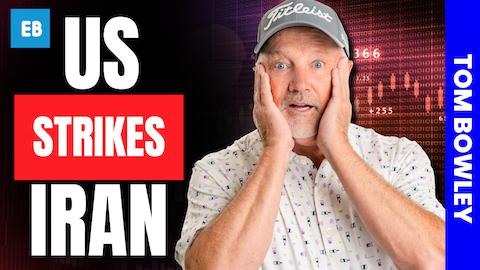
In today’s “Weekly Market Recap”, EarningsBeats.com’s Chief Market Strategist Tom Bowley looks ahead to determine the likely path for U.S. equities after the weekend bombing of Iran nuclear sites. Are crude prices heading higher? Will energy stocks outperform? What additional roadblocks might we have to negotiate after the latest Fed meeting and policy statement? Could we see fallout from June monthly options expiring on Friday? Check it all out in the video below….

Happy trading!

Tom

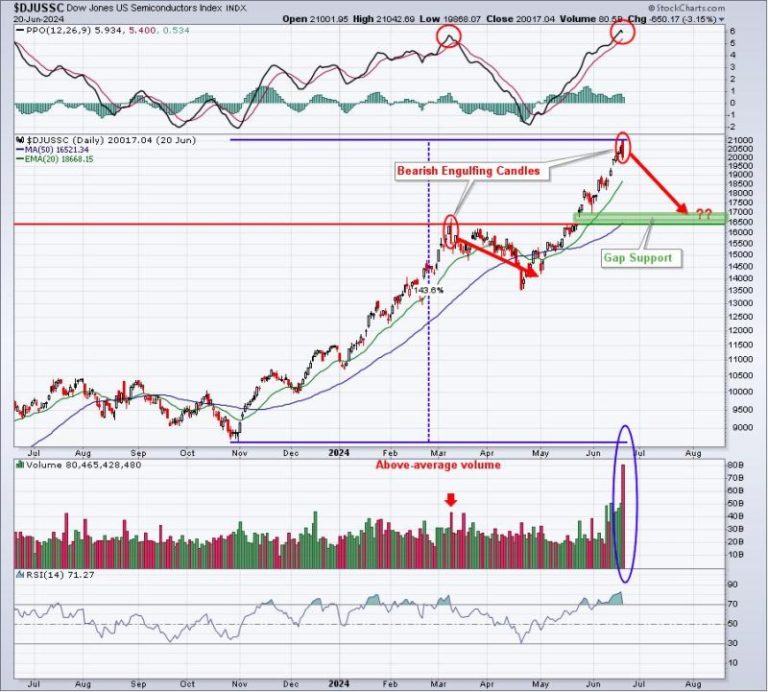
U.S. stocks are on the cusp of a very impressive breakout to all-time highs, but are still missing one key ingredient. They need help in the form of a semiconductors ($DJUSSC) breakout of its own. When the DJUSSC reached its all-time high on June 20, 2024, one year ago, a nasty bearish engulfing candle printed on extremely heavy volume, I wrote an article, “The Semiconductors Have Topped; Look Elsewhere for Opportunities”. Simply put, it was buyers’ exhaustion”. I looked for a 20% drop in the index, providing this chart at the time:

There’s now been a lengthy period of sideways consolidation on the semiconductors as you can see from this updated chart as that 20% drop immediately occurred:

Semiconductor leadership has been held firmly in check by the overhead price resistance just below 22000. Until that resistance is cleared, the QQQ has a lid on it.

Let’s keep in mind that the QQQ, an ETF that tracks the NASDAQ 100 index, can be broken down into its top 2 industry groups, as follows:

  • Semiconductors ($DJUSSC): 21.65%
  • Software ($DJUSSW): 19.11%

More than 40% of the QQQ is comprised of semiconductors and software. Here’s what the longer-term, 5-year software chart looks like:

Software’s relative strength is powerful and we’ve recently seen an absolute price breakout – an awesome combo. On a 5-year weekly chart of semis, it’s quite apparent that when the semiconductors break out, they carry the NASDAQ 100 on their shoulders higher and we’re close to a breakout now:

We just saw a relative strength breakout on the DJUSSC, there’s only one thing missing – that absolute breakout and it’s coming fairly soon, in my opinion.

Market Outlook

A big part of what happens over the next 6-12 months will be highly dependent on the two industry groups above. There are over 100 industry groups and this may be oversimplifying stocks a bit, but make no mistake about it. Higher growth prospects and lower interest rates can result in flying PE ratios and these two groups are home to companies that can expand their businesses very rapidly.

Market Manipulation

I’ve discussed the role of market makers and their manipulation of the stock market many times over the past several years and there’s no doubt in my mind we were just exposed to another massive dose of it in the first half of 2025. At EarningsBeats.com, however, we’ve become experts at spotting it and pointing it out. I discussed the importance of being in cash back in late January and in February before the massive Wall Street ripoff started and I also wrote about the importance of getting back in early. Remember my article in the second week of April, “The Bottom is Here or Rapidly Approaching”? These are real-time articles, folks. You need to see the tops and bottoms before they occur. It does little good to talk about it now. We don’t get a “do over.”

Or do we?

What do I mean by that? Well, we’ll have plenty more chances to spot tops and bottoms in the future, but you need to learn from this year’s mistakes RIGHT NOW. Don’t let these big-money, Wall Street crooks do it to you again. We have one MASSIVE advantage on our side vs. these big Wall Street firms. We can enter and exit stocks in seconds. It takes them days and weeks.

If you want to be better-positioned to see this nonsense AHEAD OF TIME the next time it comes around, I’d suggest that you join me on Saturday, June 28th at 10:00am ET for a 100% free event, “Trading The Truth: How Market Manipulation Creates Opportunity”. CLICK HERE to register and learn more about the event! This is a MUST-ATTEND event and seating is limited. Be sure to save your seat and learn how to protect your hard-earned money for the rest of your financial future!

Happy trading!

Tom