Author

admin

Browsing

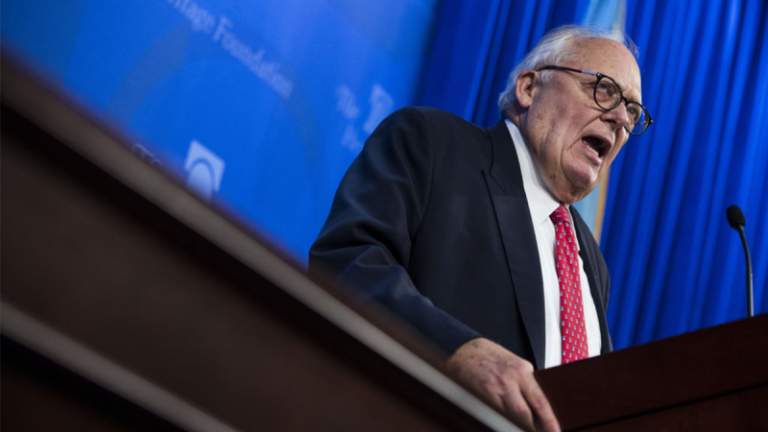
Edwin J. Feulner, a prominent figure in the American conservative movement and co-founder and former president of the Heritage Foundation, died on Friday at the age of 83.

Feulner served as the organization’s president from 1977 to 2013 and again from 2017 to 2018. He was well known for transforming the once-obscure think tank into one of the most influential policy powerhouses in Washington, D.C.

He was its longest-serving president after helping to create the Washington, D.C.-based think tank in 1973.

‘Ed Feulner was more than a leader—he was a visionary, a builder, and a patriot of the highest order,’ Heritage President Kevin Roberts and Board of Trustees Chairman Barb Van Andel-Gaby said in a joint statement. ‘His unwavering love of country and his determination to safeguard the principles that made America the freest, most prosperous nation in human history shaped every fiber of the conservative movement—and still do.’

The group had organized Project 2025, a controversial initiative that offered right-wing policy recommendations for the second Trump administration. Feulner co-wrote the initiative’s afterward and he and Roberts met with President Donald Trump ahead of last year’s election. Feulner was also on Trump’s transition team ahead of his first term.

Under his leadership, Heritage instituted a new model of conservative policy advocacy. This helped shape Reagan-era reforms and pushed market-based ideas into political mainstream. Feulner has remained active through Project 2025 and a transition plan for a second Trump term which is drawing praise and criticism for its hardline policy proposals.

An author of nine books and a former congressional aide, he was also involved in various other conservative organizations.

‘Whether he was bringing together the various corners of the conservative movement at meetings of the Philadelphia Society, or launching what is now the Heritage Strategy Forum, Ed championed a bold, ‘big-tent conservatism,” Roberts and Andel-Gaby wrote. ‘He believed in addition, not subtraction. Unity, not uniformity. One of his favorite mantras was ‘You win through multiplication and addition, not through division and subtraction.’ His legacy is not just the institution he built, but the movement he helped grow—a movement rooted in faith, family, freedom, and the founding. ‘

‘His ‘Feulnerisms’ still resonate in the halls of Heritage—where they will always be remembered. ‘People are policy,’ for instance— the heartbeat of his mission—to equip, encourage, and elevate a new generation of conservative leaders, not just in Washington, but across this great country,’ the statement continued. ‘And we still remember his adjuration to never be complacent or discouraged: ‘In Washington, there are no permanent victories and no permanent defeats.”

Roberts and Andel-Gaby vowed to honor Feulner’s life by ‘carrying his mission forward with courage, integrity, and determination.’

‘Thank you for showing us what one faithful, fearless man can do when he refuses to cede ground in the fight for self-governance,’ the leaders said of Feulner.

Heritage did not disclose Feulner’s cause of death.

Feulner is survived by his wife Lina, as well as their children and grandchildren.

This post appeared first on FOX NEWS

The U.S. shipbuilding industry is looking for help. A South Korean company is answering the call.

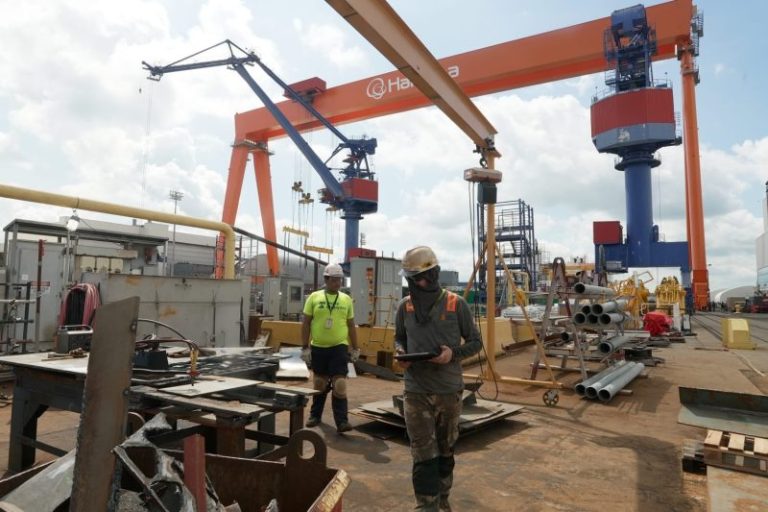
Hanwha Philly Shipyard CEO David Kim, nodding to the gargantuan vessels under construction just off the Delaware River, on Wednesday offered the kind of vision that has brought some optimism back to the U.S. shipbuilding community.

“You take that level of experience, the technology that we have, the know-how, the process expertise, and so clearly, we believe we have a lot to bring to the Philly Shipyard, as well as to the U.S. maritime industrial base, in terms of modernization capacity,” he said on a walkthrough of the shipyard.

Hanwha Philly Shipyard CEO David Kim.Obtained by NBC News

Hanwha Group bought the Philly Shipyard in December for $100 million and plans to invest multiple times that amount in the yard, training over a thousand new workers and bringing in new high-tech equipment. The company hopes to build naval ships and become the first U.S. builder of specialized liquefied natural gas tankers.

Shipbuilding in the United States has been all but dormant. China, South Korea, Japan and Europe all produce far more ships than the United States, with the few shipyards still operating in the country concentrating on military ships.

Revitalizing shipbuilding has been one of the areas President Donald Trump has pointed to as part of a broader effort to bring manufacturing back to the United States — a move some see as shortsighted considering the costs associated with building the kind of gigantic modern ships that remain a core part of how goods and commodities move around the planet.

This post appeared first on NBC NEWS

President Trump has been in office for six months, delivering on campaign promises, securing his ‘big beautiful bill’ by his self-imposed deadline and taking decisive action on the world stage.

The president was sworn into office Jan. 20, and the Trump administration has operated at warp speed since Day One.

Key tenets of Trump’s first 100 days included imposing harsh tariffs on Chinese imports, starting and continuing peace negotiations between Russia and Ukraine, and cracking down on border security amid a mass deportation initiative. 

The next chapter of the second Trump administration began, with the House of Representatives, as promised, passing Trump’s ‘One Big Beautiful Bill,’ before Memorial Day, sending it to the Senate for weeks of negotiations.

The Senate made its changes, approved the legislation and kicked it back to the House just in time for the lower chamber to pass the bill before Trump’s self-imposed Fourth of July deadline. 

The president welcomed House and Senate Republican leadership to the White House July 4 for a signing ceremony on his landmark legislation, which included key provisions that would permanently establish individual and business tax breaks included in his 2017 Tax Cuts and Jobs Act, and incorporate new tax deductions to cut duties on tips and overtime pay. 

Trump’s second administration has also focused on the new Department of Government Efficiency (DOGE), which was run by Elon Musk. DOGE proposed cuts to programs that the Trump administration chalked up to wasteful and excessive government spending.

Congressional lawmakers prepped a rescissions package — a bill to codify those DOGE cuts into law. Congress passed that package by its deadline. 

Trump signed the package Friday, which blocks $8 billion in funding to the U.S. Agency for International Development (USAID) and $1 billion to the Corporation for Public Broadcasting for the remainder of the fiscal year. The dollars had been allocated by Congress for the duration of fiscal year 2025.

As for Musk, his ‘special government employee’ window expired, and he returned to the private sector. Shortly after, Musk started a short-lived feud with the president, who chose not to prolong the tensions. Trump only hit his former ally briefly, and carried on with business as usual, leaving Musk to a lonely rant on social media.

Meanwhile, on the world stage, the president ordered strikes on Iran’s nuclear facilities. 

Trump’s historic precision strikes on Iran’s nuclear sites in June hit their targets and ‘destroyed’ and ‘badly damaged’ the facilities’ critical infrastructure — an assessment agreed upon by Iran’s Foreign Ministry, Israel and the United States. 

But Iranian Supreme Leader Ayatollah Ali Khamenei recently issued his latest threat against the U.S. and ‘its dog on a leash, the Zionist regime (Israel),’ saying that Iran’s attack on U.S. Al Udeid Air Base in Qatar was just the beginning of what Tehran could throw at Washington. He warned that ‘an even bigger blow could be inflicted on the U.S. and others.’

Iran has until the end of August to agree to a nuclear deal with the United States and its allies, Fox News has learned. 

Secretary of State Marco Rubio and the foreign ministers of France, Germany and the United Kingdom set the de facto deadline, according to three sources with knowledge of a call Wednesday among the officials. 

If Iran fails to agree to a deal, it would trigger the ‘snapback’ mechanism that automatically reimposes all sanctions previously imposed by the United Nations Security Council. 

The sanctions were lifted under the 2015 Iran deal. 

In his first six months as president, Trump also signed a sweeping order blocking travel to the U.S. from nearly 20 countries identified as high-risk for terrorism, visa abuse and failure to share security information.

The travel restrictions — announced under executive order 14161 — apply to nationals from 12 countries, including Afghanistan, Iran, Somalia, Libya and Yemen, all deemed ‘very high risk’ due to terrorist activity, weak or hostile governments, and high visa overstay rates. 

Domestically, the president has focused efforts on securing the border, with border crossings at a record low.

U.S. Customs and Border Protection reported the lowest number of border crossings in recorded history in June. Nationwide, there were 25,228 CBP encounters, the lowest monthly number the agency has recorded, including a ‘historical low’ of 8,024 apprehensions. Encounters include legal ports of entry, whereas apprehensions are arrests of those coming into the United States illegally. 

As for tariffs, the Trump administration had leveled tariffs as high as 145% on Chinese goods following the president’s reciprocal tariff plans in April, when China retaliated against the U.S. with tariffs of its own. China and the U.S. reached a preliminary trade agreement in May, which Trump said China violated in a Truth Social post at the end of May.  

An agreement was reached between the U.S. and China in June, which includes China supplying rare earth materials to the U.S., and that Trump will ‘work closely’ with Chinese President Xi Jinping ‘to open up China to American Trade.’

‘Full magnets, and any necessary rare earths, will be supplied, up front, by China,’ Trump said in June. ‘Likewise, we will provide to China what was agreed to, including Chinese students using our colleges and universities (which has always been good with me!). We are getting a total of 55% tariffs, China is getting 10%. Relationship is excellent!’ 

The president also celebrated the U.S. Army’s 250th birthday with a massive parade in Washington June 14 — kicking off a yearlong extravaganza leading up to America’s 250th birthday.

Outside the White House, Trump administration agencies have delivered on promises. 

The Department of Education unveiled plans to scale down its workforce, terminating nearly 1,400 Education Department employees. The Supreme Court upheld Trump’s move.

The Justice Department released the audio of former President Joe Biden’s interview with former Special Counsel Robert Hur. Hur was investigating Biden for alleged improper retention of classified records.

Congressional lawmakers had been demanding the audio of that interview be released since 2024, after the transcript of Biden’s interview was littered with mistakes and revealed significant memory lapses.

The Department of Justice also has started an investigation into Biden’s pardons his final days in office to determine whether they are valid. Fox News Digital has learned the pardons, in his final weeks in office, were signed by autopen, with just one signed by hand — the pardon for his son Hunter. 

Trump has also directed Attorney General Pam Bondi to make public any relevant grand jury testimony relating to the Jeffrey Epstein case. 

Over at the FBI, CIA and the Office of the Director of National Intelligence, intelligence officials and political appointees are in the process of declassifying all records related to the Trump–Russia investigation, also known as ‘Crossfire Hurricane.’

Fox News Digital also exclusively reported that former FBI Director James Comey and former CIA Director John Brennan are under criminal investigation relating to their actions tied to the Trump–Russia probe.

Fox News’ Emma Colton, Diana Stancy, Elizabeth Elkind and Louis Casiano contributed to this report. 

This post appeared first on FOX NEWS

Join Tom as he covers key inflation data, earnings season highlights, and sector rotation trends. He breaks down recent price action in major indexes like the S&P 500 and Nasdaq, with a close look at the 20-day moving average as a support gauge. Tom spotlights standout industry groups such as gambling, semiconductors, software, and aerospace, and shares charts of top-performing stocks like Goldman Sachs, Johnson & Johnson, and PNC. Tom highlights under-performing areas like insurance brokers and home improvement, then reviews several strong earnings reactions, including Monarch Casino’s 15% after-hours gain.

This video was published on July 17, 2025. Click this link to watch on Tom’s dedicated page.

Missed a session? Archived videos from Tom are available at this link

There is no denying that the broad markets remain in a resilient uptrend off the April 2025 low.  But if there’s one thing I’ve learned from many years of analyzing charts, it’s to remain vigilant during bullish phases.  Even though I’ll assume the uptrend is still intact, that doesn’t mean I can stop looking for signs of potential weakness!

With that in mind, here are three bearish candle patterns that often pop up during bullish market phases.  By looking for these patterns in the stocks and ETFs that you own, you can hopefully get ahead of any corrective moves and take profits before it’s too late!

The Shooting Star Pattern

If you see a long upper shadow, little to no lower shadow, and the open and close are close together near the bottom of the day’s range, then you have identified a shooting star candle pattern.  If you’re familiar with the hammer candle pattern, then you can think of this as a hammer candle but basically everything is upside down!

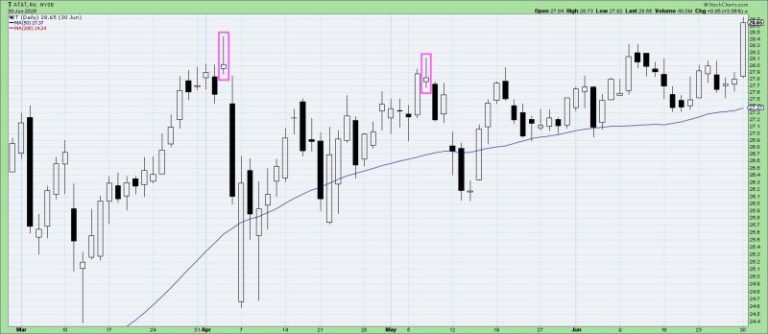
The chart of AT&T (T) has featured a number of shooting star candles so far in 2025.  Just before the selloff in early April, there was a clear shooting star candle after the March rally.  Then during the rally off the April low, a shooting star pattern in early May suggested that the uptrend phase was nearing an exhaustion point.

The Bearish Engulfing Pattern

One of the most recognizable patterns in the candlestick library, the bearish engulfing pattern represents a short-term rotation from accumulation to distribution.  Basically, a large up candle is followed by a large down candle, and the second day’s “real body” (the open-to-close range) engulfs the range of the first day’s real body.  

Look at the strength in the uptrend for Paramount Global (PARA) going into early June.  Then just before the 4th of July weekend, a bearish engulfing pattern suggests a change of character as the bears take control.  It’s worth noting that these candle patterns are not long-term signals, but rather indicate short-term dynamics.  So a bearish engulfing pattern suggests weakness for the next one to three bars.

The Evening Star Pattern

If you took the bearish engulfing pattern, and then added another small candle in the middle of those two days, then you’d have an evening star pattern.  Now most candlestick textbooks will tell you that the “star” day in the middle should include a gap, so there’s no overlap between that day’s range and the other two candles.  In practice, I’ve found most people ignore this detail and rather look for patterns with enough similarities to this basic structure.

Going back to the AT&T chart we used earlier, we can see an evening star pattern at the end of June.  A big day is followed soon after by a big down day, with a small candle in the middle.  This is a great example of where additional weakness led the price below the 50-day moving average, serving to confirm the bearish outlook as represented by the evening star pattern.

It’s so easy to become complacent during an extended bull market rally.  Investors that regularly scan for bearish candle patterns have an edge, as they can anticipate potential turning points before the uptrend changes in dramatic fashion to a new downtrend phase!

RR#6,

Dave

PS- Ready to upgrade your investment process?  Check out my free behavioral investing course!

David Keller, CMT

President and Chief Strategist

Sierra Alpha Research LLC

marketmisbehavior.com

https://www.youtube.com/c/MarketMisbehavior

Disclaimer: This blog is for educational purposes only and should not be construed as financial advice.  The ideas and strategies should never be used without first assessing your own personal and financial situation, or without consulting a financial professional.  

The author does not have a position in mentioned securities at the time of publication.    Any opinions expressed herein are solely those of the author and do not in any way represent the views or opinions of any other person or entity.

One great habit to develop as an investor is regularly scanning the stock market. Whether you’re checking for stocks that are outperforming a benchmark, gapping up, reversing, or breaking out of a trading range, scanning keeps you in the loop and, importantly, helps you stay sharp and spot potential opportunities early on. 

During one of our routine scans, one stock stood out: Rigetti Computing, Inc. (RGTI), a company in a fast-moving quantum computing space. On Wednesday, RGTI closed the day up 30%, which turned some heads. What’s behind the move? Rigetti announced significant improvements in its platform, better performance metrics, and the 36-qubit system, a technical milestone in the quantum world.  

Should You Invest in RGTI?

If you ran any of the bullish predefined scans on StockCharts, you may have noticed RGTI popping up. That alone is a good reason to take a closer look at RGTI stock’s price action.

Looking at the daily chart of RGTI, the stock had a nice ride in late 2024. However, things cooled off in early January 2025 and, since then, the stock has been trading sideways until this week. On Wednesday, RGTI gapped up with strong volume, breaking out of that sideways range.

FIGURE 1. DAILY CHART OF RGTI STOCK. Since its rise in late 2024, the stock has been trading sideways until Wednesday, when it broke out of that range. Chart source: StockCharts.com. For educational purposes.

Back in June, RGTI bounced off its 50-day simple moving average (SMA), which is starting to slope upward—a healthy technical signal. With Wednesday’s price move, RGTI is above its May 27 and July 8 highs.

RGTI’s price isn’t too far from its all-time high, set in January. If the stock breaks above that level and has strong momentum, we could see it push to new highs. The Relative Strength Index (RSI) and Percentage Price Oscillator (PPO) are showing early signs of positive momentum.

On the other hand, if the stock pulls back and Wednesday’s gap up doesn’t get filled, RGTI could reverse either at the May 27 or July 8 high. A reversal with a rise in momentum would confirm an upside continuation. If RGTI falls below these levels, fills Wednesday’s gap up, and finds support at the 50-day SMA, it could go back to trading sideways, waiting for the next catalyst. A decline below the 50-day SMA would invalidate the uptrend.

A Rising Tide in Quantum Stocks?

Other stocks in the Quantum Computing space, like IonQ, Inc. (IONQ) and D-Wave Quantum, Inc. (QBTS), also saw gains on Wednesday.

Quantum computing stocks can be a bit of a roller coaster; they rallied at the end of 2024, dipped earlier this year, and are now gaining ground, thanks to encouraging news on quantum computing developments. The technology is in its early stages and could take years before it’s truly mainstream. So while these stocks are gaining attention now, the momentum may not be consistent.

If you’re a long-term investor with patience and curiosity, it may be worth adding RGTI, QBTS, ION, and others to your ChartLists. Track them regularly and watch for continued technical strength or signs of trend reversals. 


Disclaimer: This blog is for educational purposes only and should not be construed as financial advice. The ideas and strategies should never be used without first assessing your own personal and financial situation, or without consulting a financial professional.

LaFleur Minerals Inc. (CSE: LFLR,OTC:LFLRF) (OTCQB: LFLRF) (FSE: 3WK0) (‘LaFleur Minerals’ or the ‘Company’) is pleased to announce that it has commenced its diamond drilling program at its Swanson Gold Project (‘Swanson’) in the Abitibi region, Québec, after receiving all the necessary permits including the Authorization to Intervene (ATI) and the Forestry Intervention permits. These permit approvals mark a major milestone, allowing the Company to move forward with its fully funded, minimum 5,000 metre drilling program starting with the Swanson Gold Deposit. Simultaneously, the Company announces the completion of the independent valuation of its Beacon Gold Mill (‘Beacon Mill’) by Bumigeme Inc. (‘Bumigeme’) confirming: (1) the Beacon Mill is in excellent condition, (2) with rehabilitation and commissioning costs estimated at C$4.1 million, and (3) full replacement cost of the mill and tailings storage facility combined with permitting costs estimated to exceed C$71.5 million, underscoring the strategic value of the asset. LaFleur Minerals has also significantly expanded its land position at its wholly-owned Swanson Gold Project, now covering over 18,300 hectares across 445 claims and 1 mining lease, reinforcing its district-scale exploration potential.

These recent developments mark a major operational inflection point for LaFleur Minerals:

  • Aggressive Drilling and Land Expansion: The start of a fully funded 5,000-metre drilling campaign and a significant land expansion within the Swanson Gold Project unlocking substantial discovery potential.

BUMIGEME VALUATION COMPLETE

Independent mining engineering firm Bumigeme has completed its full evaluation of the Company’s Beacon Mill in Val-d’Or, Québec and concluded that the mill is in excellent condition with anticipated rehabilitation and re-commissioning costs of C$4.1 million as part of its planned restart program. Furthermore, Bumigeme estimated the replacement CAPEX cost to build a new similar gold mill today at C$49.5 million. This cost does not include the building of a new tailings storage facility (TSF) including a tailings pond, finishing basin, piping, pumping station, etc., which is estimated at C$12 million, and mining and environmental studies and permitting costs estimated at C$10 million. Bumigeme also estimates it would take a minimum of 18 months to build a new mill and TSF, in addition to a minimum of 5 years to complete all required studies and receive all necessary permits from the federal, provincial, and municipal governments, and local and Indigenous communities prior to construction. The results of this independent valuation confirm the strong value and incredible opportunity the Beacon Mill offers for future milling of gold deposits in the Abitibi region after re-commissioning work is complete. The results of the Bumigeme evaluation will also be incorporated into the Company’s ongoing work towards a Preliminary Economic Assessment (PEA) for the Swanson Gold Project.

The Company’s next immediate priority is to secure the necessary financing to complete the rehabilitation and re-commissioning of the Beacon Gold Mill with the aim to complete the mill restart program by early 2026.

DIAMOND DRILLING COMMENCES AT SWANSON

The diamond drilling program at the Swanson Gold Project (Figure 1) will focus on priority target areas including the Swanson Gold Deposit, as well as Bartec, Jolin, and Marimac target areas (Figure 2). These high-potential zones were selected following an extensive compilation of historical data and recently completed detailed exploration work by LaFleur Minerals, including:

  • High-resolution airborne magnetic and VLF-EM surveys

  • Prospecting and soil geochemistry surveys

  • Induced polarization (IP) survey program

Drilling has already commenced at the Swanson Gold Deposit and will test key structural, geological, geochemical and geophysical anomalies for additional gold mineralization potential along strike. The Company looks forward to sharing additional details and drilling assay results in the coming weeks.

ADDITIONAL CLAIM STAKING AT SWANSON

The Company is also pleased to announce it has recently staked an additional 32 mineral claims, covering approximately 1,824 hectares, on strike and to the northwest of the Swanson Gold Deposit (Figure 3). This claims expansion extends the project’s coverage of favourable geology to over 33 kilometres of strike length, significantly enhancing Swanson’s exploration potential. The Swanson Property represents one of the largest land and mineral packages in the renowned southern Abitibi Gold Belt, which hosts favourable geology and mineralized structures. The Swanson Gold Project now includes 445 mineral claims and 1 mining lease covering a total of 18,304 hectares, positioning it as a key district-scale gold exploration play on a project that hosts over 36,000 metres of historical drilling and multiple high potential drill targets.

Paul Ténière, CEO of LaFleur Minerals stated, ‘We are very pleased with results of the full evaluation of the Beacon Gold Mill by Bumigeme and it truly shows the incredible potential of this milling asset as we advance towards becoming a near-term gold producer. Our technical team has also done an exceptional job integrating historical exploration data with new geophysical and geochemical datasets to define compelling drilling targets at Swanson. Receiving the required permits clears the way for us to advance one of the most exciting exploration and drilling campaigns in the region. Not only are we launching a fully funded, data-driven drilling program, but we’ve also strategically expanded our land position in a way that meaningfully increases our discovery potential.

Figure 1: Swanson Deposit – 50 km from the Beacon Gold Mill

To view an enhanced version of this graphic, please visit:
https://images.newsfilecorp.com/files/6526/259175_463e41b81478eb51_001full.jpg

Figure 2: Swanson drilling target regions and proposed 2025 drill holes (in blue)

To view an enhanced version of this graphic, please visit:
https://images.newsfilecorp.com/files/6526/259175_463e41b81478eb51_002full.jpg

Figure 3: Recent staking at Swanson

To view an enhanced version of this graphic, please visit:
https://images.newsfilecorp.com/files/6526/259175_463e41b81478eb51_003full.jpg

QUALIFIED PERSON STATEMENT

All scientific and technical information in this news release has been prepared and approved by Louis Martin, P.Geo. (OGQ), Exploration Manager and Technical Advisor of the Company and considered a Qualified Person for the purposes of NI 43-101.

About LaFleur Minerals Inc.

LaFleur Minerals Inc. (CSE: LFLR,OTC:LFLRF) (OTCQB: LFLRF) (FSE: 3WK0) is focused on the development of district-scale gold projects in the Abitibi Gold Belt near Val-d’Or, Québec. Our mission is to advance mining projects with a laser focus on our resource-stage Swanson Gold Project and the Beacon Gold Mill, which have significant potential to deliver long-term value. The Swanson Gold Project is approximately 18,304 hectares (183 km2) in size and includes several prospects rich in gold and critical metals previously held by Monarch Mining, Abcourt Mines, and Globex Mining. LaFleur has recently consolidated a large land package along a major structural break that hosts the Swanson, Bartec, and Jolin gold deposits and several other showings which make up the Swanson Gold Project. The Swanson Gold Project is easily accessible by road allowing direct access to several nearby gold mills, further enhancing its development potential. LaFleur Minerals’ fully-refurbished and permitted Beacon Gold Mill is capable of processing over 750 tonnes per day and is being considered for processing mineralized material at Swanson and for custom milling operations for other nearby gold projects.

ON BEHALF OF LaFleur Minerals INC.

Paul Ténière, M.Sc., P.Geo.
Chief Executive Officer
E: info@lafleurminerals.com
LaFleur Minerals Inc.
1500-1055 West Georgia Street
Vancouver, BC V6E 4N7

Neither the Canadian Securities Exchange nor its Regulation Services Provider accepts responsibility for the adequacy or accuracy of this news release.

Cautionary Statement Regarding ‘Forward-Looking’ Information

This news release includes certain statements that may be deemed ‘forward-looking statements’. All statements in this new release, other than statements of historical facts, that address events or developments that the Company expects to occur, are forward-looking statements. Forward-looking statements are statements that are not historical facts and are generally, but not always, identified by the words ‘expects’, ‘plans’, ‘anticipates’, ‘believes’, ‘intends’, ‘estimates’, ‘projects’, ‘potential’ and similar expressions, or that events or conditions ‘will’, ‘would’, ‘may’, ‘could’ or ‘should’ occur. Forward-looking statements in this news release include, without limitation, statements related to the use of proceeds from the Offering. Although the Company believes the expectations expressed in such forward-looking statements are based on reasonable assumptions, such statements are not guarantees of future performance and actual results may differ materially from those in the forward-looking statements. Factors that could cause the actual results to differ materially from those in forward-looking statements include market prices, continued availability of capital and financing, and general economic, market or business conditions. Investors are cautioned that any such statements are not guarantees of future performance and actual results or developments may differ materially from those projected in the forward-looking statements. Forward-looking statements are based on the beliefs, estimates and opinions of the Company’s management on the date the statements are made. Except as required by applicable securities laws, the Company undertakes no obligation to update these forward-looking statements in the event that management’s beliefs, estimates or opinions, or other factors, should change.

To view the source version of this press release, please visit https://www.newsfilecorp.com/release/259175

News Provided by Newsfile via QuoteMedia

This post appeared first on investingnews.com


(TheNewswire)


Brossard, Quebec, July 18, 2025 TheNewswire Charbone Hydrogen Corporation (TSXV: CH,OTC:CHHYF; OTCQB: CHHYF; FSE: K47) (the ‘Company’ or ‘CHARBONE ‘), North America’s only publicly traded pure-play company focused on green hydrogen production and distribution, is announcing regarding the previously announced, on June 3, 2025, closing of Units for debt settlements that, following discussions with the TSX Venture Exchange, the Company had to revise the total amount and number of units to be issued.


  The Company has settled with certain arm’s-length suppliers a total of $1,273,702, payable through the issuance of units. A total of 16,982,689 units will be issued upon closing, at a conversion price of $0.075 per unit. Any debt settlement will be documented in a formal agreement and is subject to final approval by the TSX Venture Exchange.  


  About Charbone Hydrogen Corporation  


  CHARBONE is an integrated company specialized in Ultra High Purity (UHP) hydrogen and the strategic distribution of industrial gases in North America and the Asia-Pacific region. It is developing a modular network of green hydrogen production while partnering with industry players to supply helium and other specialty gases without the need to build costly new plants. This disciplined strategy diversifies revenue streams, reduces risks, and increases flexibility. The CHARBONE group is publicly listed in North America and Europe on the TSX Venture Exchange (TSXV: CH,OTC:CHHYF), the OTC Markets (OTCQB: CHHYF), and the Frankfurt Stock Exchange (FSE: K47). For more information, visit     www.charbone.com    .


  Forward-Looking Statements  


  This news release contains statements that are ‘forward-looking information’ as defined under Canadian securities laws (‘forward-looking statements’). These forward-looking statements are often identified by words such as ‘intends’, ‘anticipates’, ‘expects’, ‘believes’, ‘plans’, ‘likely’, or similar words. The forward-looking statements reflect management’s expectations, estimates, or projections concerning future results or events, based on the opinions, assumptions and estimates considered reasonable by management at the date the statements are made. Although Charbone believes that the expectations reflected in the forward-looking statements are reasonable, forward-looking statements involve risks and uncertainties, and undue reliance should not be placed on forward-looking statements, as unknown or unpredictable factors could cause actual results to be materially different from those reflected in the forward-looking statements. The forward-looking statements may be affected by risks and uncertainties in the business of Charbone. These risks, uncertainties and assumptions include, but are not limited to, those described under ‘Risk Factors’ in the Corporation’s Filing Statement dated March 31, 2022, which is available on SEDAR at www.sedar.com; they could cause actual events or results to differ materially from those projected in any forward-looking statements.  


  Except as required under applicable securities legislation, Charbone undertakes no obligation to publicly update or revise forward-looking information.  


  Neither TSX Venture Exchange nor its Regulation Services Provider (as that term is defined in policies of the TSX Venture Exchange) accepts responsibility for the adequacy or accuracy of this release   .  


  Contact Charbone Hydrogen Corporation  


  Telephone: +1 450 678 7171  


  Email:     ir@charbone.com    


  Benoit Veilleux  


  CFO and Corporate Secretary  


Copyright (c) 2025 TheNewswire – All rights reserved.


News Provided by TheNewsWire via QuoteMedia

This post appeared first on investingnews.com


(TheNewswire)


    Brossard (Québec), le 1   8   juillet 2025 –   TheNewswire      CORPORATION CHARBONE HYDROGÈNE     (TSXV: CH,OTC:CHHYF   , OTCQB: CHHYF, FSE: K47   ) («   Charbone   » ou la «   Société   »), une rare compagnie cotée en bourse spécialisée dans la production et la distribution d’hydrogène vert en Amérique du Nord, annonce une mise-à-jour, concernant la clôture des unités pour le règlement de dettes annoncée précédemment, le 3 juin 2025, que, suite à des discussions avec la Bourse de croissance TSX, la Société a dû réviser le montant total et le nombre d’unités à émettre.  


  La Société a réglé avec certains fournisseurs sans lien de dépendance un montant total de 1 273 702 $, payable par émission d’unités. Un total de 16 982 689 unités seront émises à la clôture, au prix de conversion de 0,075$ l’unité. Tout règlement de dette sera formalisé par une entente officielle et est soumis à l’approbation finale de la Bourse de croissance TSX.  


  À propos de Charbone Hydrogène Corporation  


  Charbone est une entreprise intégrée spécialisée dans l’hydrogène ultrapur (UHP) et la distribution stratégique de gaz industriels en Amérique du Nord et en Asie-Pacifique. Elle développe un réseau modulaire de production d’hydrogène vert tout en s’associant à des partenaires de l’industrie pour offrir de l’hélium et d’autres gaz spécialisés sans avoir à construire de nouvelles usines coûteuses. Cette stratégie disciplinée diversifie les revenus, réduit les risques et augmente sa flexibilité. Le groupe Charbone est coté en bourse en Amérique du Nord et en Europe sur la bourse de croissance TSX (TSXV: CH,OTC:CHHYF); sur les marchés OTC (OTCQB: CHHYF); et à la Bourse de Francfort (FSE: K47). Pour plus d’informations, visiter     www.charbone.com     .  


  Énoncés prospectifs  


  Le présent communiqué de presse contient des énoncés qui constituent de « l’information prospective » au sens des lois canadiennes sur les valeurs mobilières (« déclarations prospectives »). Ces déclarations prospectives sont souvent identifiées par des mots tels que « a l’intention », « anticipe », « s’attend à », « croit », « planifie », « probable », ou des mots similaires. Les déclarations prospectives reflètent les attentes, estimations ou projections respectives de la direction de Charbone concernant les résultats ou événements futurs, sur la base des opinions, hypothèses et estimations considérées comme raisonnables par la direction à la date à laquelle les déclarations sont faites. Bien que Charbone estime que les attentes exprimées dans les déclarations prospectives sont raisonnables, les déclarations prospectives comportent des risques et des incertitudes, et il ne faut pas se fier indûment aux déclarations prospectives, car des facteurs inconnus ou imprévisibles pourraient faire en sorte que les résultats réels soient sensiblement différents de ceux exprimés dans les déclarations prospectives. Des risques et des incertitudes liés aux activités de Charbone peuvent avoir une incidence sur les déclarations prospectives. Ces risques, incertitudes et hypothèses comprennent, sans s’y limiter, ceux décrits à la rubrique « Facteurs de risque » dans la déclaration de changement à l’inscription de la Société datée du 31 mars 2022, qui peut être consultée sur SEDAR à l’adresse www.sedar.com; ils pourraient faire en sorte que les événements ou les résultats réels diffèrent sensiblement de ceux prévus dans les déclarations prospectives.  


  Sauf si les lois sur les valeurs mobilières applicables l’exigent, Charbone ne s’engage pas à mettre à jour ni à réviser les déclarations prospectives.  


  Ni la Bourse de croissance TSX ni son fournisseur de services de réglementation (tel que ce terme est défini dans les politiques de la Bourse de croissance TSX) n’acceptent de responsabilité quant à la pertinence ou à l’exactitude du présent communiqué.  


  Pour contacter Corporation Charbone Hydrogène :  


Téléphone bureau: +1 450 678 7171


Courriel:   ir@charbone.com   


Benoit Veilleux


Chef de la direction financière et secrétaire corporatif


Copyright (c) 2025 TheNewswire – All rights reserved.


News Provided by TheNewsWire via QuoteMedia

This post appeared first on investingnews.com

Senators are not thrilled with a top White House official’s comments that the government funding process should become more partisan, and fear that doing so could erode Congress’ power of the purse.

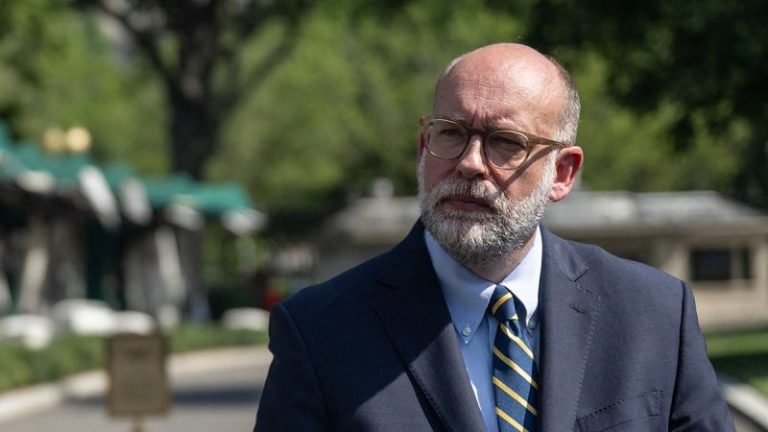
Office of Management and Budget Director Russ Vought told reporters during a Christian Science Monitor Breakfast Thursday morning that he believed ‘the appropriations process has to be less bipartisan.’

His sentiment came on the heels of Senate Republicans advancing President Donald Trump’s $9 billion clawback package, which would cancel congressionally approved funding for foreign aid and public broadcasting, just a few hours before.

Unlike the hyper-partisan bills that have dominated the Senate’s recent agenda, including the rescissions package and the president’s ‘big, beautiful bill,’ the appropriations process is typically a bipartisan affair in the upper chamber.

That is because, normally, most bills brought to the floor have to pass the Senate’s 60-vote threshold, and with the GOP’s narrow majority, Senate Democrats will need to pass any spending bills or government funding extensions to ward off a partial government shutdown.

Senate Majority Leader Chuck Schumer, D-N.Y., who alluded to issues down the line with the appropriations process if Republicans advanced Trump’s resicssions package, took a harsh stance against Vought. 

‘Donald Trump should fire Russell Vought immediately, before he destroys our democracy and runs the country into the ground,’ Schumer said. 

Members of the Senate Appropriations Committee also did not take kindly to Vought’s comments.

‘I think he disrespects it,’ Sen. Lisa Murkowski, R-Alaska, said. ‘I think he thinks that we are irrelevant, and I wish I had actually heard the speech, because, you know, again, everything in context.’

‘But you have to admit that when you look at the quotes that are highlighted in the story this morning, it is pretty dismissive of the appropriations process, pretty dismissive,’ she continued.

Vought has no intention of slowing the rescissions train coming from the White House, and said that there would be more rescissions packages on the way.

He noted another would ‘come soon,’ as lawmakers in the House close in on a vote to send the first clawback package to the president’s desk.

‘There is no voter in the country that went to the polls and said, ‘I’m voting for a bipartisan appropriations process,’’ Vought said. ‘That may be the view of something that appropriators want to maintain.’

Both Murkowski and Senate Appropriations Chair Susan Collins, R-Maine, voted against the rescissions package, and warned of the cuts to public broadcasting, lack of transparency from the OMB and the possible effect it could have on legislating in the upper chamber.

‘I disagree with both those statements,’ Collins said of Vought’s push for a more partisan appropriations process. ‘Just as with the budget that the President submitted, we had to repeatedly ask him and the agencies to provide us with the detailed account information, which amounts to 1000s of pages that our appropriators and their staff meticulously review.’

Fox News Digital reached out to the OMB for comment. 

Vought’s comments came at roughly the same time as appropriators were holding a mark-up hearing of the military construction and veterans’ affairs and Commerce, Justice and Science spending bills.

Sen. Patty Murray, the top Democrat on the Senate Appropriations Committee, said during the hearing that Senate Republicans coalescing behind the rescissions package would only make hammering out spending bills more difficult, and argued that ‘trust’ was at the core of the process.

‘That’s part of why bipartisan bills are so important,’ she said. ‘But everyone has to understand getting to the finish line always depends on our ability to work together in a bipartisan way, and it also depends on trust.’

Other Republicans on the panel emphasized a similar point, that, without some kind of cooperation, advancing spending bills would become even more challenging.

Sen. John Hoeven, R-N.D., said that finding ‘critical mass’ to move spending bills was important, and warned that people have to ‘quit saying it’s gotta just be my way or the highway,’ following threats Schumer’s threats last week that the appropriations process could suffer should the rescissions package pass. 

‘People better start recognizing that we’re all gonna have to work together and hopefully get these [appropriations] bills to the floor and see what we can move,’ he said. ‘But if somebody just sits up and says, ‘Oh, because there’s a rescission bill, then I’m not going to work on Appropriations,’ you can always find an excuse not to do something. Let’s figure out how we can work forward.’

This post appeared first on FOX NEWS