Author

admin

Browsing

Questcorp Mining Inc. (CSE: QQQ,OTC:QQCMF) (OTCQB: QQCMF) (FSE: D910) (the ‘Company’ or ‘Questcorp’) is pleased to announce that it’s Maiden drilling program at the La Union gold and silver Project in Sonora, Mexico, is progressing on track and on budget, with three of the five main targets now having some initial drilling and work continuing toward completion of the current program. This update follows the Company’s August 6, 2025 announcement marking the start of the program and August 19 and September 10 news releases chronicling the progress of the program.

Saf Dhillon, President and Chief Executive Officer, states: ‘The maiden drill program has been indicating consistency with past mining, and targets are progressing with positive exploration drilling so far. The drilling is intersecting more quartzite than expected which is favorable for fracture-controlled mineralization. The property Operator, Riverside operations team is handling the current exploration program working with the local rancher and the drilling company to efficiently complete the first phase of this exploration program.’

The first hole at the Union Mine target was drilled southeast beneath historic workings, cutting through the Clemente and Caborca formations-both key host units for past mining at Union as described in the filed NI 43-101 report on SEDAR+ by Questcorp Mining (https://www.sedarplus.ca/csa-party/records/document.html?id=48299afdea2a73385e0513ce830753e11ddf957ee61888b81d46e76fa281ac17).

The hole ended in the Caborca Formation, encountering the distinctive microconglomeratic carbonate unit that historically hosted mineralization at the bottom of the Union Mine. Samples from this hole have been delivered to Bureau Veritas in Hermosillo, Sonora, for gold fire assay, with pulps to be sent to Vancouver, Canada, for ICP-MS analysis with 4-acid digestion to determine silver, base metal, and multi-element values. This consistent analytical approach has been applied since the outset of the Union program to ensure comparability across results.

Drilling then moved to the northern part of the project, testing two target areas: the El Cobre Mine area and the North Union Mine area. Here, holes were oriented perpendicular to stratigraphy and toward interpreted feeder zones along pre-mineral fault structures, primarily within the Clemente Formation. Drilling in these areas has intersected more quartzite than initially modeled, with extensive hematitic oxides-an encouraging sign for potential gold mineralization, possibly linked to sulfides that have been oxidized through supergene weathering. Historic mining in the district targeted oxides only, leaving sulfide zones untested. Riverside plans to evaluate this potential beneath past workings across four target areas: Union Mine, El Cobre, North Union, and Famosa.

The program has now moved south to the Famosa target, where two initial holes are planned to test beneath and along strike from historic workings toward a steeply west-dipping, north-south-trending fault structure, as well as into host rocks on either side of this major structural feature. Famosa produced gold historically, with reported grades exceeding ½ oz/ton Au in archived records referenced in the NI 43-101 report. The Company is encouraged by the target’s potential and is eager to advance drilling here.

Once this initial campaign is completed, follow-up work will integrate assay results, ongoing surface programs, additional induced polarization (IP) surveys, and refined geological interpretations based on stratigraphy and structure observed in drilling. The greater-than-expected quartzite content in the Clemente Formation supports the evolving model of fracture- and quartz-pyrite veinlet-hosted gold mineralization, which will help sharpen targeting at the Union Project. Core from all drilling has been logged, saw-cut, and half-core samples sent for assay, with remaining halves retained for reference and cataloging.

The Company looks forward to completing the Famosa drilling, receiving the pending assay results, and providing further updates as this program progresses.

Figure 1. Geologic map with the tenure of the Union internal concession shown in pink. Manto and chimney type CRD targets are shown as red polygons. Riverside now controls all mineral tenures on this map. The drill program will focus on the Union Mine and areas north of the Union Mine with the initial drill work.

To view an enhanced version of this graphic, please visit:
https://images.newsfilecorp.com/files/10197/267723_25b092fc440cbaba_001full.jpg

Figure 2. Cross section looking west with conceptual drill targets and schematic drillhole traces. Assays from Riverside’s sampling of rock dump materials from the two mine areas are labeled in black. Red areas are interpreted as manto and chimney target bodies that are now well defined and drill ready. Assays shown on figures 1 and 2 have been previously released and disclosed as summarized below the geochemical QA/QC and in published NI 43-101 Report that Questcorp published 2025 on SEDAR+.

To view an enhanced version of this graphic, please visit:
https://images.newsfilecorp.com/files/10197/267723_25b092fc440cbaba_002full.jpg

Qualified Person & QA/QC:

The technical content of this news release has been reviewed and approved by R. Tim Henneberry’, P. Geo (BC) a Director of the Company and a Qualified Person under National Instrument 43-101.

Rock samples from previous exploration programs discussed above at the Project were taken to the Bureau Veritas Laboratories in Hermosillo, Mexico for fire assaying for gold. The rejects remained with Bureau Veritas in Mexico while the pulps were transported to Bureau Veritas laboratory in Vancouver, BC, Canada for 45 element ICP/ES-MS analysis using 4-acid digestion methods. A QA/QC program was implemented as part of the sampling procedures for the exploration program. Standards were randomly inserted into the sample stream prior to being sent to the laboratory.

About Questcorp Mining Inc.

Questcorp Mining is engaged in the business of the acquisition and exploration of mineral properties in North America, with the objective of locating and developing economic precious and base metals properties of merit. The company holds an option to acquire an undivided 100-per-cent interest in and to mineral claims totalling 1,168.09 hectares comprising the North Island copper property, on Vancouver Island, B.C., subject to a royalty obligation. The company also holds an option to acquire an undivided 100-per-cent interest in and to mineral claims totalling 2,520.2 hectares comprising the La Union project located in Sonora, Mexico, subject to a royalty obligation.

ON BEHALF OF THE BOARD OF DIRECTORS,

Saf Dhillon
President & CEO

Questcorp Mining Inc.
saf@questcorpmining.ca
Tel. (604-484-3031)

Suite 550, 800 West Pender Street
Vancouver, British Columbia
V6C 2V6.

Certain statements in this news release are forward-looking statements, which reflect the expectations of management regarding completion of survey work at the North Island Copper project. Forward-looking statements consist of statements that are not purely historical, including any statements regarding beliefs, plans, expectations or intentions regarding the future. Such statements are subject to risks and uncertainties that may cause actual results, performance or developments to differ materially from those contained in the statements. No assurance can be given that any of the events anticipated by the forward-looking statements will occur or, if they do occur, what benefits the Company will obtain from them. Except as required by the securities disclosure laws and regulations applicable to the Company, the Company undertakes no obligation to update these forward-looking statements if management’s beliefs, estimates or opinions, or other factors, should change.

To view the source version of this press release, please visit https://www.newsfilecorp.com/release/267723

News Provided by Newsfile via QuoteMedia

This post appeared first on investingnews.com

(TheNewswire)

Vancouver, British Columbia, September 24th, 2025 TheNewswire – Prismo Metals Inc. (the ‘ Company ‘) (CSE: PRIZ,OTC:PMOMF) (OTCQB: PMOMF) is pleased to report that it has received preliminary assay results for the first batch of twenty-three samples taken at its Silver King project located in Arizona. This assay data highlights the different types of mineralization identified in the Company’s news releases of August 28 th and September 15 th 2025 (Figure 1).

‘These assay results confirm the exploration potential at the Silver King project,’ said Dr. Craig Gibson, Chief Exploration Officer. ‘Three samples with silver values reported as greater than 200 g/t were taken from the Silver King mine dump and from the new polymetallic vein recognized in our recent exploration program. Samples with high copper values, that also exhibit important gold values, are largely from the replacement mineralization which is similar to the type of mineralization at the nearby Magma mine.’

Several of the samples have reported values that are greater than the detection limit for the analytical method used. The analytical laboratory must re-analyze these samples by a different method, and the Company is expecting to receive these overlimit assays for silver, copper, lead and zinc within about two weeks. Upon receipt of the over limit assays Prismo will issue a further news release and use this information to help prioritize targets for the further exploration, including the upcoming drilling program. Additional samples, including samples from the Ripsey Mine are currently being analyzed and results are expected in the coming weeks.

‘Much of the focus of the exploration program to date has consisted of a property wide survey of historic mines and prospects surrounding the direct Silver King workings,’ said Gordon Aldcorn, President of Prismo’. This work has expanded our geological thinking and resulted in the recognition of several new types of mineralization at the project, providing additional targets for exploration. We are presenting the assay results for each of the exploration areas, namely the new mineralized veins (polymetallic and copper), stratigraphically controlled replacement mineralization and the area around the Silver Mine. Each of the areas will be prioritized for further exploration, including drilling.   The initial phase of Prismo exploration on the Silver King project confirmed the exploration potential in several areas. Our upcoming drill program is currently in the permitting stage and is anticipated to be advanced shortly.

Figure 1 . Geologic and land map of the Silver King project showing newly described polymetallic vein in magenta (Ag-Pb-Zn), copper vein in green (Cu-Ag) and stratigraphically controlled replacement mineralization in red.  The strongly altered intrusion with stock work quartz-pyrite veining is indicated by the crosshatch.

New Mineralized Veins (polymetallic and copper veins)

As previously reported in Prismo s news release of August 28, 2025, the Company geologists identified two previously undescribed veins in the area surrounding the historic glory hole developed on the original exposure of high-grade silver at the Silver King deposit.  The assay results confirm the visual inspection and indicate that there are two distinct veins, one with abundant silver, lead and zinc and the other with copper and silver values.

These veins provide additional exploration targets outside of the area of historic mine workings and may provide information on the controls to mineralization in the pipelike mineralized body.

Sample

Au g/t

Ag g/t

Cu %

Pb %

Zn %

Sb ppm

Bi ppm

Ba ppm

Hg ppm

New polymetallic vein

544509

26

0.02

0.17

0.07

562

0.1

140

0.14

544510

0.03

>200

>1.0

>1.0

>1.0

7788

0.3

>10000

12.84

Cu vein

544553

0.005

183

0.31

0.02

0.03

21.6

0.5

157

0.18

544554

0.009

198

0.29

0.01

0.03

24.5

0.6

92

0.02

544504

44

0.10

0.01

0.02

396

0.2

524

0.13

Table 1. Assay results for selected samples from newly identified veins at the Silver King project.

Stratigraphically Controlled Replacement Mineralization

Several samples were taken along the stratigraphic horizon that hosts replacement and skarn mineralization in numerous small workings. Several samples assayed more than 1% copper and generally contain elevated gold values.

Figure 2. Copper assays for samples taken at the Silver King project.

The m ineralization in this area is similar to that at the Magma mine. It is exposed in several historic mine workings with abundant oxide copper minerals, mainly malachite . These were developed along a northeast dipping limestone horizon near the contact with a quartz diorite intrusion and quartzite . It is located along the same structural and stratigraphic trend of the Magma mine located 0.6 to 1.5 kilometers to the southwest. The largest occurrence, at the Black Diamond mine in the eastern portion of the claim block, was developed on a large outcrop of abundant specular hematite and malachite replacing a limestone bed (Fig. 2) .

Table 2. Assay results for selected samples from the replacement area at the Silver King project.

Sample

Au g/t

Ag g/t

Cu %

Pb %

Zn %

Sb ppm

Bi ppm

Ba ppm

Hg ppm

Cu replacement zone

544501

0.01

3

0.01

0.03

1.9

0.4

171

0.13

544502

0.47

7

>1.0

0.02

0.8

71.8

30

544505

0.03

5

0.75

0.01

2.9

3.2

22

0.05

544507

2.26

25

>1.0

0.23

0.4

33.5

12

0.01

544508

0.73

12

>1.0

0.28

0.4

29.1

12

0.03

544552

35

0.14

>1.0

>1.0

114

0.5

24

2.11

Figure 3 .  Map showing Silver King project and nearby mineral deposits. The Silver King deposit is located three kilometers from the Resolution Copper deposit (a joint venture between Rio Tinto and BHP) and the high-grade Magma mine, a former copper and silver producer.

Around The Silver King Mine

Two samples were taken of mineralized fragments from the dump around the Silver King workings.  Samples 544514 is composed of selected fragments of quartz vein material with variable amounts of sulfide minerals including stromeyerite (AgCuS), freibergite (CuAgSbS) and base metal sulfides.  Sample 544517 is composed of stockwork veins and breccia with about 50% wall rock fragments.  These two compositions are believed to represent the dominant types of mineralization that will be encountered in and adjacent to the pipelike Silver King mineralized body.

Table 3. Assay results for selected samples from the Silver King mine.

Sample

Au g/t

Ag g/t

Cu %

Pb %

Zn %

Sb ppm

Bi ppm

Ba ppm

Hg ppm

Silver King mine

544514

1.07

>200

0.59

0.44

0.63

337

3

>10000

1.7

544517

0.04

>200

0.09

0.26

0.43

377

0.2

>10000

15.66

Several additional elements are important in characterizing the different types of mineralization.  The high silver in the Silver King mineralization is associated with gold, copper, lead, zinc and antimony as well as barium and mercury.  The copper replacement mineralization contains important gold along with bismuth.

Figure 4. Silver assays for samples taken at the Silver King project.

Figure 5 . Gold assay values for the Silver King exploration program.

Sample

Location

Type/width (m)

E WGS84

N WGS84

544501

Black Diamond

1.0

492,698

3,687,650

544502

Black Diamond

Grab

492,633

3,687,623

544504

Collapsed shaft

Dump

492,217

3,687,916

544505

Replacement zone

0.75

492,318

3,687,521

544507

Replacement zone

Dump

492,054

3,687,431

544508

Replacement zone

0.7

491,986

3,687,334

544509

Polymetallic vein

2.0

491,833

3,687,546

544510

Polymetallic vein

Dump

491,863

3,687,565

544514

Silver King Mine

Dump

491,855

3,687,907

544517

Silver King Mine

Dump

491,855

3,687,907

544552

Replacement zone float

Selected

491,928

3,688,043

544553

Silver King Mine

0.4

492,037

3,687,881

544554

Silver King Mine

0.4

492,037

3,687,881

Table 4. Locations for samples mentioned in the text.

Exploration Next Steps

Prismo has submitted a plan of operations for the drill program with the Forest Service. The drill permit is expected by the end of October. A drill program is planned for Silver King, with a minimum of 1,000 meters initially. This first phase of the drill program is designed to test the upper half of the steeply dipping pipelike Silver King mineralized body as well as potentially mineralization adjacent to the dense stockwork that was the focus of historic mining.  Follow up drilling will expand on the initial program based on the results and also include separate targets outside of the historic mining area, such as the polymetallic vein mentioned above. The discovery of the two mineralized veins and porphyry style mineralization has resulted in Prismo evaluating a larger drill program to test those targets.

QA/QC

Samples were analyzed by SGS, an internationally recognized analytical lab, with preparation at the Tempe, Arizona facility and analyses at the Burnaby laboratory.  Prismo inserts controls samples consisting of standard pulps and coarse blanks in the sample stream for QA/QC purposes and also utilizes the labs internal control samples.

Qualified Person

Dr. Craig Gibson, PhD., CPG., a Qualified Person as defined by NI-43-01 regulations and Chief Exploration Officer and a director of the Company, has reviewed and approved the technical disclosures in this news release. The historic data presented in this press release was obtained from public sources, should be considered incomplete and is not qualified under NI 43-101, but is believed to be accurate. The Company has not verified the historical data presented and it cannot be relied upon, and it is being used solely to aid in exploration plans. References to mineralization at the Magma Mine and Resolution Copper deposit is not necessarily indicative to the mineralization on the Silver King property.

About the Silver King

Discovered in 1875, the Silver King mine was one of Arizona s most important historic producers, yielding nearly 6 million ounces of silver at grades of up to 61 oz/t.  The Silver King mine sits only 3 km from the main shaft of the Resolution Copper project — a joint venture between Rio Tinto and BHP and one of the world s largest unmined copper deposits with an estimated copper resource of 1.787 billion metric tonnes at an average grade of 1.5% copper (1) . The unique land position is fully surrounded by Resolution Copper s claim block, offering strategic upside. Selected samples from small-scale production in the late 1990s returned grades as high as 644 oz/t silver (18,250 g/t) and 0.53 oz/t gold (15 g/t), indicating that high-grade mineralization remains.

(1) https://resolutioncopper.com/about-us/

About Prismo Metals Inc.

Prismo (CSE: PRIZ,OTC:PMOMF) is a mining exploration company focused on advancing its Silver King, Ripsey and Hot Breccia projects in Arizona and its Palos Verdes silver project in Mexico.

Please follow @PrismoMetals on , , , Instagram , and

Prismo Metals Inc.

1100 – 1111 Melville St., Vancouver, British Columbia V6E 3V6

Phone: (416) 361-0737

Contact:

Alain Lambert, Chief Executive Officer alain.lambert@prismometals.com

Gordon Aldcorn, President gordon.aldcorn@prismometals.com

Cautionary Note Regarding Forward-Looking Information

This release includes certain statements and information that may constitute forward-looking information within the meaning of applicable Canadian securities laws. Forward-looking statements relate to future events or future performance and reflect the expectations or beliefs of management of the Company regarding future events. Generally, forward-looking statements and information can be identified by the use of forward-looking terminology such as intends’ or anticipates’, or variations of such words and phrases or statements that certain actions, events or results may’, could’, should’, would’ or occur’. This information and these statements, referred to herein as ‘forward‐looking statements’, are not historical facts, are made as of the date of this news release and include without limitation, statements regarding discussions of future plans, estimates and forecasts and statements as to management’s expectations and intentions with respect to, among other things: the timing, costs and results of drilling at Silver King.

These forward‐looking statements involve numerous risks and uncertainties, and actual results might differ materially from results suggested in any forward-looking statements. These risks and uncertainties include, among other things: delays in obtaining or failure to obtain appropriate funding to finance the exploration program at Silver King.

In making the forward-looking statements in this news release, the Company has applied several material assumptions, including without limitation, that: the ability to raise capital to fund the drilling campaign at Silver King and the timing of such drilling campaign.

Although management of the Company has attempted to identify important factors that could cause actual results to differ materially from those contained in forward-looking statements or forward-looking information, there may be other factors that cause results not to be as anticipated, estimated or intended. There can be no assurance that such statements will prove to be accurate, as actual results and future events could differ materially from those anticipated in such statements. Accordingly, readers should not place undue reliance on forward-looking statements and forward-looking information. Readers are cautioned that reliance on such information may not be appropriate for other purposes. The Company does not undertake to update any forward-looking statement, forward-looking information or financial outlook that are incorporated by reference herein, except in accordance with applicable securities laws. We seek safe harbor.

Copyright (c) 2025 TheNewswire – All rights reserved.

News Provided by TheNewsWire via QuoteMedia

This post appeared first on investingnews.com

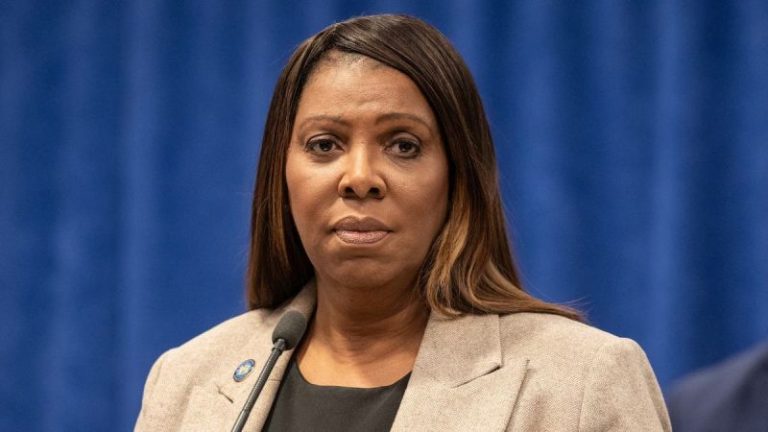
President Trump just fired a top federal prosecutor because he failed to bring charges against two despised opponents, New York Attorney General Letitia James and ex-FBI chief James Comey.

The ouster of Erik Siebert, U.S. attorney for Virginia’s Eastern District — and Trump’s own appointee — came after he couldn’t find sufficient evidence to charge James with mortgage fraud.

The president blamed the firing on Siebert having been put forward by two Democratic senators – hardly a secret – under the archaic ‘blue slip’ requirement that should be abolished.

‘Yeah, I want him out,’ Trump said after ABC broke the story. Tish James is ‘very guilty of something.’

What’s more, ‘he didn’t quit, I fired him!’

It’s a blip of a story, compared to Trump and his team naming a special prosecutor to again investigate Russiagate allegations from 2016; dropping corruption charges against New York’s Mayor Eric Adams, and suspending security clearances for the law firm that Robert Mueller left four years ago (later blocked by a judge).

The larger point is that perhaps we’ve become inured to the serious spectacle of a president not just interfering with the Justice Department but literally dictating who should be charged and who should be protected.

Trump told Pam Bondi over the weekend, ‘They impeached me twice, and indicted me (five times!), OVER NOTHING. JUSTICE MUST BE SERVED, NOW!!!’ 

He said he believes James, Comey and Democratic Sen. Adam Schiff are ‘all guilty as hell’ but that nothing is being done.

As someone who used to roam the halls of the Justice Department — and covered three independent counsels involving Ronald Reagan’s AG, Ed Meese — I am acutely aware of the ethical boundaries. 

After the Watergate scandal, which included Attorney General John Mitchell going to prison, led to reforms, the idea of a wall between the White House and DOJ was further cemented. 

Joe Biden saw any involvement in criminal probes as radioactive, and no evidence of his tampering has surfaced (though he did pardon a bunch of allies, including his son).

There was a huge uproar back when Bill Clinton had a chance tarmac meeting with his AG, Loretta Lynch, while his wife was under investigation over her private email server. She said they talked about grandchildren and travel. A CBS reporter called the meeting ‘absolutely shocking.’ 

But you don’t have to rely on unnamed sources to learn about Trump giving his attorney general marching orders. He broadcasts it, even boasts about it.

Of course, Trump stretching his executive powers goes well beyond DOJ. There are his funding freezes against universities, dispatching of the National Guard in D.C. and elsewhere, and attempting to fire members of supposedly independent agencies such as the Federal Reserve.

The escalation against the media has been nothing short of stunning. Trump cheered ABC’s suspension of Jimmy Kimmel against the backdrop of FCC Chairman Brendan Carr threatening to take action against its local licenses. ‘We can do this the easy way or the hard way,’ he said, prompting some conservatives to say he sounded like a mafioso.

Trump won a $16 million settlement from ABC over George Stephanopoulos saying Trump had been held liable for ‘rape,’ not sexual abuse. He also won $16 million from CBS over the biased editing of a ’60 Minutes’ interview with Kamala Harris. 

It just so happens that Nexstar, which preempted Kimmel and owns many CBS affiliates, needs administration approval to take over Tegna, another media conglomerate.

Trump filed suit against the Wall Street Journal for reporting he’d sent a birthday message to Jeffrey Epstein with a silhouette of a naked woman–and when that surfaced with what closely resembled his signature, continued to deny he had done it.

And then there is his $15 billion suit against the New York Times, which a judge threw out after just four days for its ‘inexcusable’ breaking of the rules in a filing filled with ‘vituperation.’ It’s a strange suit because it wasn’t triggered by any particular story, just a general charge that the Times campaign coverage was illegal, including a Harris endorsement that ran on the front page.

Even the largest corporations have to spend big bucks to defend such suits, which is sort of the point.

But nothing is as sensitive and powerful as law enforcement, whose officials can shield allies and prosecute opponents.

The president’s position is that DOJ was weaponized against him during the Biden administration, and therefore he’s entitled to payback.

The latest news just broke. The Justice Department was investigating border czar Tom Homan for allegedly offering to help win federal contracts to businessmen — who were actually undercover FBI agents — in exchange for $50,000.

But as MSNBC reports, Trump’s DOJ dropped the case after he took office.
Since the hidden-camera encounter took place before Trump was elected, when Homan was a private citizen, I could argue he was just doing what hundreds of lobbyists do. Except for one nagging detail — Homan took the 50K in cash, in a Cava fast-food bag. No paper trail.

And yet Pam Bondi’s department gave him a pass.

Prosecutors in every administration must make difficult judgment calls about whether they have enough evidence to convict, especially against government officials or high-profile figures. 

And next time there’s a Democrat in the White House, what’s to stop that person from playing the same kind of hardball, saying their party was entitled to payback? The cycles could be endless.

As for now, it would be easier to have confidence in these prosecution decisions if the president wasn’t openly calling the shots. 

This post appeared first on FOX NEWS

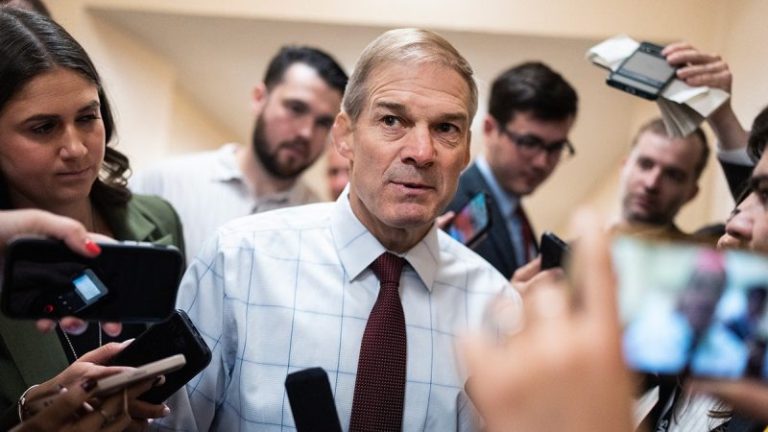
A conservative climate policy group is urging House Judiciary Committee Chairman Rep. Jim Jordan, R-Ohio, to subpoena records from the Environmental Law Institute’s Climate Judiciary Project as part of an ongoing probe into the influence of climate advocacy groups in climate policy litigation. 

Jason Isaac, CEO of the American Energy Institute, a conservative pro-U.S. energy production policy group, wrote a letter to Jordan last week pointing to evidence from a Sept. 12 Multnomah County v. ExxonMobil et al. court filing that he says suggests ‘covert coordination and judicial manipulation.’

‘This new evidence raises serious red flags about the credibility of both the so-called science being used in climate lawsuits and the judicial training programs behind the bench,’ Isaac told Fox News Digital. 

According to Isaac’s letter to Jordan, the court filing submitted by Chevron Corporation earlier this month reveals that ‘one of the plaintiffs’ lead attorneys, Roger Worthington, had undisclosed involvement in at least two so-called scientific studies that the county is presenting as independent, peer-reviewed evidence.’

One of those studies ‘acknowledged funding from the Climate Judiciary Project in a draft version, but that disclosure was inexplicably removed from the final publication,’ Isaac said in the letter. 

Earlier drafts of the study, labeled ‘DO NOT DISTRIBUTE,’ were found on Worthington’s law firm website, the letter revealed. 

According to the American Energy Institute, the study seeks to ‘attribute global economic losses from climate change to specific oil companies.’ The website also included a ‘pre-publication draft of a CJP judicial training module’ with internal editorial comments, according to the letter. 

Isaac told Jordan this mark-up raises ‘serious questions about how and why a plaintiffs’ attorney had early access to, and possibly editorial influence over, materials being presented to state and federal judges as ‘neutral’ science.’

Another module was designed to ‘educate’ participant judges on how to apply ‘attribution science’ in the courtroom, according to Isaac. 

Attribution science seeks to measure how much human-caused climate change is responsible for certain extreme weather events, per Science News Explores’ definition. 

‘The Environmental Law Institute has claimed neutrality, yet documents suggest coordination with plaintiffs’ counsel who stand to profit from the outcomes,’ Isaac told Fox News Digital. ‘If the same lawyers suing energy companies are shaping the studies and educating the judges, that is not justice; it is manipulation. Congress is right to dig deeper, and the American Energy Institute is proud to support that effort.’ 

Isaac is requesting that Jordan formally request ‘communications, draft documents, funding agreements, and internal editorial notes related to the scientific studies and CJP curriculum.’

While commending Jordan’s leadership, Isaac said, ‘Judges and the public deserve to know whether the courtroom is being quietly shaped by coordinated climate advocacy posing as neutral expertise.’

Isaac said the Environmental Law Institute and Worthington should answer several questions about their involvement in the studies, including the ‘judicial education module on attribution science.’

‘Does ELI regularly seek input from plaintiffs’ attorneys on its judicial education modules?’ Isaac questioned. 

‘ELI did not fund the Nature study, and the Climate Judiciary Project has not coordinated with Mr. Worthington,’ Environmental Law Institute spokesman Nick Collins told Fox News Digital in a statement. 

‘CJP does not participate in or provide support for litigation,’ Collins added. ‘Rather, CJP provides evidence-based continuing education to judges about climate science and how it arises in the law. Our curriculum is fact-based and science-first, grounded in consensus reports and developed with a robust peer review process that meets the highest scholarly standards.’

When 23 Republican state attorneys general sent a letter last month to Environmental Protection Agency chief Lee Zeldin calling on him to cancel funding to the Environmental Law Institute, Collins told Fox News Digital that the Climate Judiciary Project’s projects are far from ‘radical.’

‘The programs in which the Climate Judiciary Project (CJP) participates are no different than other judicial education programs, providing evidence-based training on legal and scientific topics that judges voluntarily choose to attend,’ Collins said.

Fox News Digital has reached out to Jordan and Worthington for comment on the letter but did not immediately hear back. 

Fox News Digital’s Emma Colton contributed to this story. 

This post appeared first on FOX NEWS

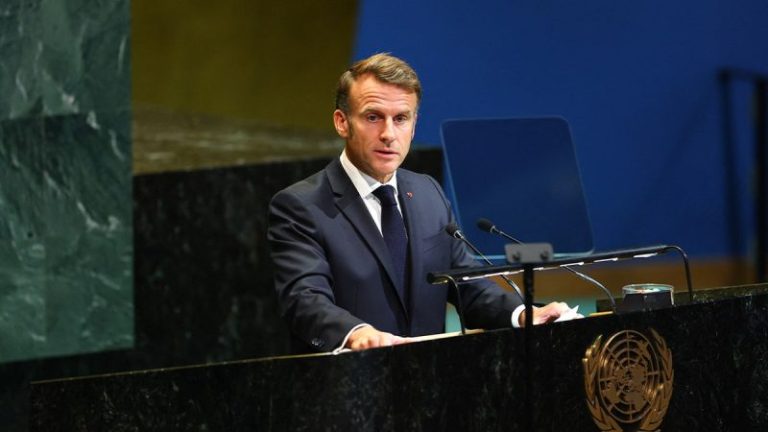
French President Emmanuel Macron’s push for Palestinian statehood at the United Nations clashed sharply with Donald Trump’s message — but the two leaders’ rivalry also played out in the streets of New York in an unexpected way.

At the UN General Assembly, Macron formally announced France’s recognition of a Palestinian state, insisting the move was ‘essential to peace.’ Trump, speaking today, blasted the recognition as a ‘reward’ for Hamas’s ‘horrible atrocities, including October 7,’ that would only prolong conflict.

But away from the UN stage, the two presidents collided in an unusual moment when Macron was stopped at a crosswalk by New York police as Trump’s motorcade rolled through Manhattan. ‘Sorry President, everything is frozen, the motorcade moving now,’ one officer told him. Macron, visibly frustrated, replied, ‘If you don’t see it, let me cross.’

With the road blocked, Macron picked up his phone and called President Trump directly. According to a video circulating online, the French president said: ‘Guess what, I’m waiting in the street because everything is frozen for you.’ Only after the call was the road eventually cleared.

Macron then walked through the city for nearly half an hour, trailed by passersby who stopped him for selfies. One person planted a kiss on his head. Macron laughed off the encounter, saying, ‘It’s just a kiss, makes no harm.’

France’s embassy in the U.S official X account leaned into the moment with humor: ‘It’s a good thing our presidents have each other on speed dial… If you’ve ever had to walk through NYC during UNGA, this is 110% relatable content.’

This post appeared first on FOX NEWS

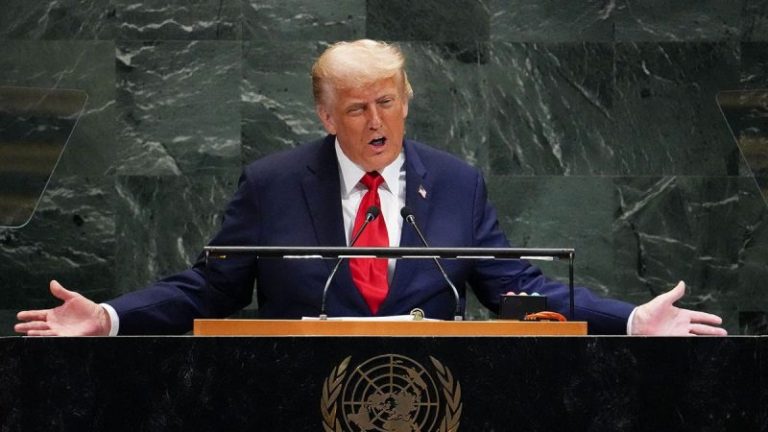
When President Donald Trump took the stage at the United Nations General Assembly (UNGA), the teleprompter didn’t work. But no matter — he was about to deliver a series of points he knew well, and one that shattered the typical U.N. script.

At times, world leaders shifted uncomfortably in their seats, particularly when he charged that the U.N. had failed to help the U.S. end wars and joked that all he ever got from the institution was being stuck on an escalator and a broken teleprompter. Yet in his trademark style, Trump also drew laughter from the room, managing to be both affable and scolding at the same time.

‘What is the purpose of the United Nations?’ Trump asked, after recounting how he — not the U.N. — had ended seven wars. 

From there, he launched into a wide-ranging address that touched on every one of the U.N.’s modern priorities — climate change, Ukraine, refugee resettlement and Palestinian statehood—and rejected each of them outright, unsettling many in attendance.

Latvian Foreign Minister Baiba Braže told Fox News Digital world leaders took note of Trump’s blunt style and sweeping agenda. She emphasized that his remarks spanned ‘a whole set of international issues,’ from Ukraine to Gaza. She highlighted his criticism of Russia, saying it was clear he wanted the war to end and was openly disappointed in President Vladimir Putin.

Former U.S. diplomat Hugh Dugan noted that while Trump hammered the U.N., he did not press the case for reform as forcefully as expected. 

‘As for U.N. reform and criticizing and guiding it through financial crises and endemic dysfunctionality, surprisingly he left a vacuum instead of a narrative,’ Dugan said. ‘He neither validated nor criticized the U.N. as expected, except pointing out the obvious views of its administrative and diplomatic passivity shared widely.’

Climate change

For the U.N., climate change is an existential threat requiring global action. Trump mocked the entire concept as ‘the greatest con job ever perpetrated on the world,’ deriding green energy as ‘all bankrupt’ and declaring the carbon footprint ‘a hoax.’ Dismissing decades of climate change work at the U.N., he said: ‘No more global warming, no more global cooling, whatever the hell happens, it’s climate change.’

Braže noted that European nations still see the U.N. as the central forum for tackling global problems, even if reforms are overdue. ‘We might differ in our opinion where we still think the U.N. is a valuable organization and the U.N. charter is a basis of [the] international system,’ she said, adding: ‘Of course it needs change… stepping up efficiencies.’

Ukraine

Trump and the international body are largely aligned on wanting the war in Ukraine to come to an end, but Trump criticized its European members sharply for continued reliance on Russian oil.

Trump argued the war ‘would never have started if I were president’ and accused NATO allies of hypocrisy and said some NATO allies were ‘funding the war against themselves’ by buying Russian oil.

‘They’re buying oil and gas from Russia while they’re fighting Russia. It’s embarrassing to them… they have to immediately, immediately cease all energy purchases from Russia.’

He threatened tariffs unless Europe cut off energy purchases from Moscow, but blamed India and China as the ‘primary funders of the war’ through Russian fuel purchases. The president also once again promised a ‘very strong round of powerful tariffs’ if Russia refuses peace.

Braže said Latvia welcomed Trump’s commitment to ending the war, even as she underscored Europe’s reliance on the U.N. system. ‘He also explained, of course, his efforts to achieve peace in various regions which we welcome,’ she said.

Estonian Foreign Minister Margus Tsahkna echoed Trump’s point that Russia’s war effort is not unstoppable. ‘As for the president’s speech, it was good to hear that Trump is dedicated to peace in Ukraine, and he also hinted that Russia is defeatable. We believe that as well,’ Tsahkna said. ‘Estonia has long said that Russia’s energy exports are its main source of revenue, and the engine behind its war in Ukraine. That’s why we must do more to cut off this funding.’

Migration

Where the U.N. sees migration as a shared humanitarian challenge, Trump painted it as an ‘invasion.’ He accused the U.N. of bankrolling illegal immigration into the U.S., citing U.N. cash and food assistance for migrants, and warned that uncontrolled migration was ‘ruining’ Europe.

‘The U.N. is supposed to stop invasions, not create them and not finance them,’ Trump said. ‘Your countries are being ruined. Europe is in serious trouble. They’ve been invaded by a force of illegal aliens like nobody’s ever seen before.’

He claimed migrants in London want to impose ‘Sharia law.’

‘I look at London where you have a terrible mayor, terrible, terrible mayor. And it’s been so changed, so changed. Now they want to go to Sharia law, but you’re in a different country. You can’t do that.’

Braže said the Baltic States share skepticism about uncontrolled migration, rooted in their history under Soviet rule. ‘In some European countries, political correctness overcame the need to limit immigration. For us in the Baltics, immigration has always been something that we are quite skeptical about,’ she said. ‘That is due to the fact when the Soviet Union occupied us for 50 years we were not able to define our own rules… so today we are very clear that our borders are our borders, we control them.’

Palestinian statehood

While the U.N. pushes for recognition of Palestinian statehood as part of a two-state solution, Trump blasted such efforts as ‘a reward for Hamas.’ He argued it would encourage terrorism and instead demanded the immediate release of Israeli hostages — and made calls for peace. 

Dugan said the White House calculated carefully how to handle the Palestinian issue. ‘He denied added publicity for the Palestinian statehood matter, while robbing his critics of a snarky quotable they depend upon. His team would say that they opted not to throw more gas on that fire, I suppose.’

‘We have to stop the war in Gaza immediately. We have to immediately negotiate peace,’ Trump said.

But French President Emmanuel Macron said that if Trump really wants peace, he has to put pressure on Israel to end the war. 

‘There is one person who can do something about it, and that is the U.S. president. And the reason he can do more than us, is because we do not supply weapons that allow the war in Gaza to be waged. We do not supply equipment that allows war to be waged in Gaza. The United States of America does,’ Macron told France’s BFM TV after the speech. 

Macron went on: ‘I see an American president who is involved, who reiterated this morning from the podium: ‘I want peace. I have resolved seven conflicts’, who wants the Nobel Peace Prize. The Nobel Peace Prize is only possible if you stop this conflict.’

Behnam Taleblu of the Foundation for Defense of Democracies said Trump’s handling of Iran, where the president touted the U.S.’s offensive strikes on Iran’s nuclear program, in particular stood out. ‘The calmness and even casualness with which President Trump spoke about the elimination of the Islamic Republic’s military leaders at the UNGA today shows an understanding and willingness to embrace America’s superpower status against its adversaries not often seen,’ Taleblu said.

The broader UN message

Beyond individual issues, Trump’s message was that the U.N. itself was failing. He ridiculed its reliance on ‘strongly worded letters’ and its expensive renovation projects, portraying the body as corrupt and ineffective.

‘I’ve attended UNGA a few times. Never have I heard a speech like this. Trump was right on one thing: the UN is paralyzed,’ Tobias Ellwood, a former British member of Parliament, shared on X. But he warned major conflict is ‘likely to follow’ if the UN dissolves like the League of Nations did.

But Dugan suggested Trump stopped short of offering a roadmap. ‘He went to tier-2 topics (immigration and green energy) because they are tier-1 with MAGA,’ he said. ‘Given the teleprompter and the escalator, he seems resigned to the fact that the place is not teachable when it comes to organization turnaround — certainly not while [Secretary General Antonio] Guterres continues.’

Trump launched a review of the U.N. six months ago, and Dugan said he’d hoped to hear more about its findings in the speech. It’s ‘not evident’ that the review was ‘deep, good or even completed.’ 

Looking ahead, Dugan warned that Trump’s silence on deeper U.N. reform left space for rivals. ‘Next: let’s see if China is editing its speech now to swoop down to fill the missing narrative vacuum,’ he said.

Behnam Taleblu of the Foundation for Defense of Democracies said Trump was also making a point about the U.N.’s lack of engagement. ‘The President also foot-stomped the fact that he has received relative silence from the U.N. system and its leaders in the face of numerous ceasefires and deconfliction agreements he helped broker in warzones around the world. For an organization aimed at stemming or resolving conflict, the silence is deafening.’

This post appeared first on FOX NEWS

Treasury Secretary Scott Bessent and U.S. Trade Representative Jamieson Greer met with Chinese Vice Premier He Lifeng and Commerce Minister Li Chenggang in Madrid last week. They announced a ‘framework agreement’ over TikTok, the Chinese-owned app used by millions of Americans. 

But the story isn’t only about TikTok. It’s also about how America uses TikTok as a lever – and why that lever is more necessary than ever.

TikTok is an important issue in and of itself: control over data, algorithmic influence, foreign ownership – all of which are critical for national security. In addition, however, TikTok is a tool the U.S. can and should use in ongoing trade engagement, as well as to counter China’s growing leverage in rare earths, critical minerals and semiconductors.

When I served in President Donald Trump’s first administration (‘Trump 45’), the core issues we confronted included a massive trade imbalance, intellectual property theft, cyber-theft and China’s Belt and Road infrastructure expansion. These were predatory practices in trade, tech and finance. Today, in ‘Trump 47,’ the battlefront has broadened – but one thing that hasn’t changed is the psychological warfare the Chinese employ any time negotiations are underway.

I was at the center of one of the most dramatic examples of this during Trump 45… 

After an exhausting month of prep work, I boarded my flight to Beijing in March 2018 with wary optimism. I had worked intensively leading up to this trip, drafting a comprehensive framework document outlining a new trade deal with China, a proposal that would overhaul virtually every aspect of the U.S.-China economic relationship.

We’d sent the proposal to our Chinese counterparts several days earlier, and now our high-level trade delegation was en route to Beijing to negotiate the largest change to trade relations in at least 10 years. The cast of characters illustrates just how significant this trade deal could be. It included Secretary Steven Mnuchin (head of the delegation), Under Secretary David Malpass and me (Treasury), Secretary Wilbur Ross (Commerce), U.S. Trade Representative Robert Lighthizer and several of his deputies, NEC Director Larry Kudlow, Under Secretary Ted McKinney (Agriculture), and Peter Navarro (special assistant to the president and director of trade and manufacturing policy).

We arrived at the U.S. Embassy in Beijing with about an hour to review our plans one more time before we had to depart for Diaoyutai – the state guest house where Mao and every leader since has entertained foreign dignitaries. But there was a surprise waiting for us at our embassy:a brand-new proposal, drafted by the Chinese, which they were putting forth at the eleventh hour, and which we had never seen. It was about 15 pages long – and completely in Chinese!

I was one of the few people in the room who could read it. After a quick scan, I told the group: ‘This is wholly unacceptable. This document doesn’t say anything – they’re just messing with us.’ A heated debate ensued over how to respond, and how the Chinese were likely to react. But there was no time to reach a consensus; it was time to leave for Diaoyutai.

There was a mass exit from the secure room where we met at the embassy, and, almost like a well-choreographed ballet with a hundred moving parts, we all shuffled to our designated cars. As Secretary Mnuchin stepped into the limousine to take us to the meeting, Malpass insisted that I ride with the secretary and pushed me into the seat next to Mnuchin, saying, ‘We need to know exactly what this says – can you translate it on the way?’

As we sped through the streets of Beijing, I sat in the back seat, literally shvitzing as a technical term in Chinese got the better of me, and furiously translated as I read out loud, in English, what the Chinese had dropped in our laps.

Even as we climbed the stairs into the building and entered the meeting room, none of us was quite sure how Mnuchin was going to handle this hot potato. After Vice Premier Liu He’s flowing stream of diplomatic pleasantries welcoming us to China, the secretary calmly stated in response, ‘We received your draft. Thanks for sending it over – but we’re going to use our draft for today.’ It wasn’t the preamble they expected. But it was entirely consistent with the new tone that President Trump had set from the day he took office.

Today, China has moved from using tariffs and IP theft to controlling choke points – especially in rare earth elements, critical minerals, semiconductors and advanced manufacturing capacity. The numbers are clear indicators of China’s leverage. 

China accounts for about 70 % of global rare earth mining and about 90 % of the world’s rare earth refining and separation capacity. In 2023, China controlled 61 % of global mining of rare earth magnet elements and 92 % of refining capacity for those magnets. 

On semiconductors: while U.S. companies remain strong in chip design and advanced R&D, China’s share of the semiconductor industry’s value-added has surged (from about 8 % in 2001 to over 30 % by 2016), and China is pushing aggressively to become self-sufficient in mature node production.

These are not passive metrics. They are active levers China already uses in the trade negotiations through export restrictions, licensing controls or by threatening disruptions. For example, in April 2025 China – clearly in response to President Trump’s bold tariff moves – added export licenses and restrictions for seven heavy rare earth elements, including dysprosium, terbium, samarium, plus rare earth magnets—materials critical to EV motors, wind turbines, electronics and defense systems.

The challenges faced in Trump’s first term have only evolved – not eased. The trade deficit is large, IP and tech theft are growing more dangerous, predatory development finance practices continue and China’s leverage in rare earths, semiconductors and control over supply chains threatens global development and American autonomy.

TikTok is a headline issue impacting critical issues of data, influence and national security. But it is also an essential lever to counter the new pressure points China is pressing. Madrid and Friday’s Trump–Xi call offer a chance to reshape this broader contest. 

As I demonstrate in ‘A Seat at the Table,’ President Trump’s strategy and policies during his first administration allowed us to exert maximum pressure on our counterparts and to stay the course with firm negotiating positions and clear red lines. Last week’s dialogues demonstrate that Trump will continue to insist on substance over symbolism, an approach critical to our national interest. 

This post appeared first on FOX NEWS

The new store reopens featuring an all-new design, Apple’s latest retail innovations, and a special Today at Apple session with supergroup Number_i

Apple® today announced the grand reopening of Apple Ginza on Friday, September 26, located in the vibrant Ginza district where Apple’s retail journey in Japan began more than two decades ago. Opened in 2003 as Apple’s first store outside the U.S., Apple Ginza now returns in an all-new four-story design that brings together the best of Apple’s products, services, and experiences in one beautifully reimagined space.

This press release features multimedia. View the full release here: https://www.businesswire.com/news/home/20250923937921/en/

Apple Ginza will reopen on Friday, September 26, located in the vibrant Ginza district where Apple’s retail journey in Japan began more than two decades ago.

‘Apple Ginza holds a special place in our hearts as our very first Retail store outside the US, and its opening more than 20 years ago marked a new chapter in how we connect with our customers around the world,’ said Tim Cook, Apple’s CEO. ‘This reopening is another incredible milestone on our journey here in Japan, and a symbol of our strong ties to customers and communities across the country. We couldn’t be more excited to open the doors to this beautifully redesigned space, share our latest products, and build on the incredible history we share.’

‘We’re so excited to reopen Apple Ginza in its original location, with a magical new experience for our customers,’ said Deirdre O’Brien, Apple’s senior vice president of Retail and People. ‘We’re thrilled to welcome everyone back to this iconic store with an all-new design and incredible local programming, where they can experience the very best of Apple’s products and services.’

Discover and Shop Apple

At Apple Ginza, customers can discover and shop the full lineup of Apple products, including iPhone® 17, iPhone Air, iPhone 17 Pro, iPhone 17 Pro Max, Apple Watch® Series 11, Apple Watch Ultra 3, Apple Watch SE 3 and AirPods Pro® 3, as well as accessories like the iPhone Air Bumper, the iPhone Air Case with MagSafe®, and the all-new Crossbody Strap. Customers can celebrate the opening with a special-edition Apple Gift Card, available only at this store for a limited time.

Customers can experience only-at-Apple retail services like personalized shopping sessions with an Apple Specialist, monthly financing options, and upgrading through the Apple Trade In® program — a great way to apply the value of a current device toward the purchase of a new one. The dedicated Apple Pickup area makes it easy for customers to order from the Apple Store® online and collect in-store at a time that’s convenient for them.

Special Sessions

To celebrate the reopening, Apple Ginza will launch a special Today at Apple® Spotlight session in collaboration with Japanese supergroup Number_i, exploring Spatial Audio and spatial video through their single, ‘U.M.A.’ The session will debut exclusively at Apple Ginza before expanding to stores across Japan on October 11. Fans can also book one-on-one demos of Apple Vision Pro to step into an immersive behind-the-scenes look at the ‘U.M.A.’ music video in the Spatial Gallery app.

Customers can explore the full range of daily Today at Apple sessions, including the new and updated ‘Tips: What’s New on iOS 26’ and ‘Say Hello to iPhone 17 and iPhone 17 Pro,’ providing more ways to get the most out of the latest Apple products.

Designed for Tokyo

Like all Apple facilities, Apple Ginza’s operations are powered by 100 percent renewable energy. The store’s thoughtful layout combines sustainability with a distinctly modern design, incorporating regionally sourced materials and a double-skin glass façade with adaptive louvers that help regulate light and temperature throughout the day. Its reimagined layout floods each floor with natural light and offers balcony-like spaces overlooking the vibrant streets of Ginza. Inside, warm wooden paneling nods to Japanese design.

The new store also features varied table and seating heights to support all customers as they shop for their favorite devices, and dedicated spaces for services, including Genius Bar to personalized setup.

Customers are encouraged to download a custom wallpaper , listen to a curated Apple Music Ginza Playlist , and sign up for upcoming Today at Apple sessions . Apple Ginza opens to customers Friday, September 26, at 10 a.m. JST.

NOTE TO EDITORS: For additional information visit Apple Newsroom ( www.apple.com/newsroom ), or email Apple’s Media Helpline at media.help@apple.com .

© 2025 Apple Inc. All rights reserved. Apple, the Apple logo, iPhone, Apple Watch, AirPods Pro, MagSafe, Apple Trade In, Apple Store, Today at Apple, and Apple Vision Pro are trademarks of Apple. Other company and product names may be trademarks of their respective owners.

View source version on businesswire.com: https://www.businesswire.com/news/home/20250923937921/en/

Pia Fontes
Apple
pia_fontes@apple.com

Brian Bumbery
Apple
bumbery@apple.com

News Provided by Business Wire via QuoteMedia

This post appeared first on investingnews.com

FPX Nickel Corp. ( TSX-V: FPX) (OTCQB: FPOCF ) (‘ FPX ‘ or the ‘ Company ‘) is pleased to announce the signing of an option agreement to acquire up to 100% of the Advocate Nickel Property (‘ Advocate ‘ or the ‘ Property ‘) in Newfoundland . Concurrently, the Company is pleased to report that the Japan Organization for Metals and Energy Security (‘ JOGMEC ‘) has accepted Advocate as the first Designated Property within the FPX-JOGMEC Generative Alliance, and that a significant work program is planned to expand upon the encouraging Davis Tube Recoverable (‘ DTR ‘) nickel values obtained from surface sampling to-date.

Highlights

  • The large, highly prospective, Advocate Nickel Property covers 86.25 km 2 and includes over 45 km strike length of serpentinized ultramafic rocks, the suitable host rock formation for awaruite mineralization
  • Three sizeable zones of awaruite mineralization have been discovered to date at Advocate, with surface rock samples returning DTR nickel grades of up to 0.14% and remaining open in all directions
  • JOGMEC and FPX have established a budget of $450,000 for Advocate exploration activities in 2025, with work expected to define drill targets at one or more zones through property-wide rock sampling and grid-based top-of-bedrock sampling in areas with limited outcrop

‘After reviewing over 50 targets in 10 jurisdictions worldwide, including 11 in Newfoundland , we have selected Advocate as the first Designated Project to be advanced by our FPX-JOGMEC Generative Alliance,’ commented Keith Patterson , FPX’s Vice President, Exploration. ‘Geologically, we see many similarities between awaruite mineralization at Advocate and our Baptiste Project in British Columbia , which boasts Probable Mineral Reserves of 1,488 Mt at an average grade of 0.13% DTR nickel (per the Company’s 2023 preliminary feasibility study). We are excited to unearth the full potential at Advocate through high-quality, systematic exploration over the coming years in tandem with our partners.’

Advocate Nickel Property

The Advocate Nickel Property is located in north-central Newfoundland , approximately 20 km southwest of the historic mining town of Baie Verte (Figure 1). The mineral licenses are 8,625 hectares in size, covering highly prospective, serpentinized ultramafic rocks and include over 45 km of strike length of the Advocate Complex ophiolite. Access to the Property is via a good quality network of logging roads, generally no more than 5 to 10 km from the Trans Canada Highway or Newfoundland highway 410. The Property vendor currently operates a deep-sea port at Pine Cove, approximately 50 km northeast of the Property.

Reconnaissance rock sampling to date, with over 200 samples collected to-date, has delineated three zones of high-grade awaruite mineralization, including the Wolverine Pond, Birchy Lake North, and Birchy Lake targets.

Wolverine Pond Zone

The Wolverine Pond target covers an area of approximately 1,600m x 500m and remains open in several directions. Awaruite mineralization is currently defined by 28 rock samples which have returned up to 0.14% DTR nickel and show the following distribution of DTR nickel grades:

DTR Ni (%)

Number of samples

> 0.10

4

0.08 – 0.10

1

0.06 – 0.08

10

0.04 – 0.06

11

2

Future planned work at the Wolverine Pond Zone includes additional rock sampling and top-of-bedrock sampling in areas of till cover to more precisely delineate awaruite mineralization. Successful results from these planned programs would be expected to lead to an inaugural drill program.

Birchy Lake Zone

The Birchy Lake target is currently defined by sixteen surface rock samples covering a 500 x 400 metre area, with the zone remaining open in most directions. Of these sixteen rock samples, fifteen returned greater than 0.04% Davis Tube Recoverable (‘ DTR ‘) nickel, four returned greater than or equal to 0.08% DTR nickel, and the highest-grade sample returned 0.12% DTR nickel.

Next steps at the Birchy Lake Zone include additional rock sampling and top-of-bedrock sampling in areas of till cover. It is expected that this work will lead to the delineation of drill targets at Birchy Lake.

The Birchy Lake North target is defined by only five rock samples covering an approximately 500 m strike length. It remains open to the northeast and southwest. DTR nickel grades range from 0.07% to 0.13%. Significantly more rock sampling and top-of-bedrock sampling is warranted at this zone.

Advocate Nickel Mineralogy and Total Nickel Values

Mineralogical analysis in the form of QEMSCAN (Quantitative Evaluation of Minerals by Scanning Electron Microscopy) was performed on eleven sub-samples of the magnetic fraction of Advocate rock samples produced by DTR magnetic separation. The presence of awaruite was confirmed in all eleven samples tested; higher-grade samples were determined to contain abundant coarse-grained awaruite. The presence of coarse-grained awaruite provides additional confidence that the awaruite at Advocate is likely to be recoverable using magnetic separation similar to that demonstrated in bench- and pilot-scale testing for Baptiste mineralization.

Total nickel values in ultramafic rock samples collected to date from the Advocate Property range from 0.18% to 0.29% and average 0.23%. These values are consistent with typical background nickel values from ultramafic rocks sampled globally and do not represent potentially recoverable nickel. The high DTR nickel values obtained from the Advocate zones indicate that the nickel in these target areas is primarily contained in awaruite with grain sizes sufficiently coarse to be recovered by magnetic separation.

FPX-JOGMEC Joint Venture

After careful review of both geological and business considerations, JOGMEC has elected to accept the Advocate Nickel Property as the first new Designated Property to be advanced to project specific work within the broader FPX-JOGMEC Generative Alliance. Going forward, JOGMEC will have the ability to obtain a 60% interest in Advocate and will fund 60% of expenditures; FPX will hold the remaining 40% interest in Advocate and will fund 40% of expenditures for the project.

A preliminary budget of $450,000 has been approved for Advocate for 2025, in addition to the $1.5 million budget for ongoing global generative activities. Ongoing exploration at Advocate includes property-wide rock sampling and excavator test pitting to allow for rock sampling in areas without outcrop due to till cover. The goal of the current program is to delineate drill targets at one or more zones by year-end.

Option Agreement Terms

The Company has signed an option agreement (‘ Agreement ‘) to acquire up to 100% of the Advocate Nickel Property from Shoreline Exploration Inc. (‘ Shoreline ‘). The Agreement splits the option into a three-year first option (the ‘ First Option ‘) which allows the Company to acquire up to 80% of the Property, and an additional five-year option (the ‘ Second Option ‘) allowing the Company to purchase the remaining 20%. An overview of the option terms is presented below.

First Option

  • Three-year term
  • Staged cash payments totaling $225,000
  • Staged work commitments totaling $2,500,000
  • The Company to earn an 80% interest in the Advocate Nickel Property upon completion of the First Option work commitments and cash payments

Second Option

  • Five-year term commencing on the completion of the First Option
  • Cash payment of $6,000,000 to purchase the remaining 20% of the Advocate Nickel Property for a total of 100% ownership

Sampling and Analytical Method

One- to two-kilogram rock samples were collected in the field from outcrop or locally sourced float in areas where outcrop was unavailable. Locations were documented using handheld GPS units. Once bagged, tagged, and sorted, samples were shipped to Activation Laboratories in Ancaster, Ontario .

Sample preparation involved crushing the entire sample to 80% less than 2 mm, riffle splitting 250 g, and pulverization of the split to greater than 95% passing 74 microns. Analytical procedures included whole rock analysis by lithium metaborate/tetraborate fusion ICPOES, Davis Tube magnetic separation, and lithium borate fusion XRF analysis on the magnetic separate. The DTR nickel grade is calculated by multiplying the magnetic separate XRF fusion nickel value by the weight of the magnetic fraction, divided by total recorded weight.

QA/QC procedures included the insertion of industry-standard commercial standards in all phases of the analytical procedures, duplicates at multiple stages in the preparation procedures and blanks. All QA/QC protocols were performed by Activation Laboratories. The DTR method is a bench scale metallurgical test procedure and is used to provide a measure of magnetically recoverable nickel and is the global, industry standard for geometallurgical testing for magnetic recovery operations and exploration projects.

Qualified Person

Keith Patterson , P.Geo., FPX’s Vice President, Exploration, FPX’s Qualified Person under NI 43-101, has reviewed and approved the scientific and technical content of this news release.

About FPX Nickel Corp.

FPX Nickel Corp.  is focused on the exploration and development of the Baptiste Nickel Project, located in central British Columbia , and other occurrences of the same unique style of naturally occurring nickel-iron alloy mineralization known as awaruite.  For more information, please view the Company’s website at https://fpxnickel.com/ or contact Martin Turenne , President and CEO, at (604) 681-8600 or ceo@fpxnickel.com .

On behalf of FPX Nickel Corp.

‘Martin Turenne’
Martin Turenne , President, CEO and Director

Forward-Looking Statements

Certain of the statements made and information contained herein is considered ‘forward-looking information’ within the meaning of applicable Canadian securities laws. These statements address future events and conditions and so involve inherent risks and uncertainties, as disclosed in the Company’s periodic filings with Canadian securities regulators. Actual results could differ from those currently projected. The Company does not assume the obligation to update any forward-looking statement.

Neither the TSX Venture Exchange nor its Regulation Services Provider accepts responsibility for the adequacy or accuracy of this release.

SOURCE FPX Nickel Corp.

View original content to download multimedia: http://www.newswire.ca/en/releases/archive/September2025/23/c4993.html

News Provided by Canada Newswire via QuoteMedia

This post appeared first on investingnews.com